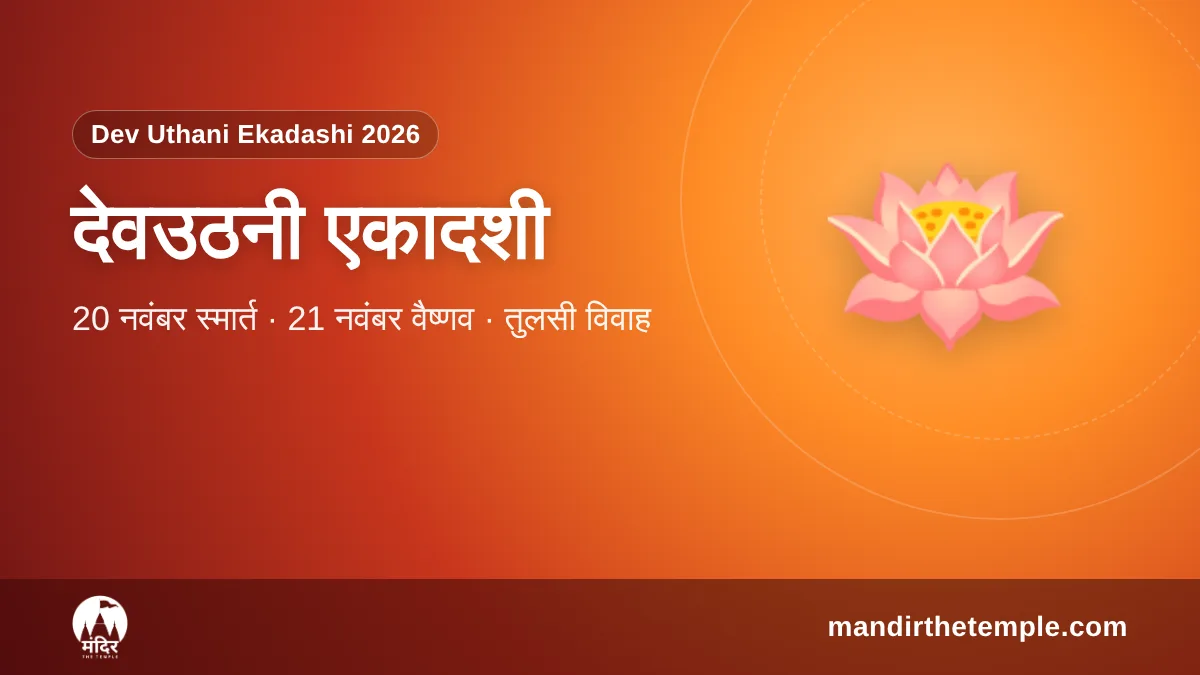
Dev Uthani Ekadashi, also called Prabodhini Ekadashi and Devotthan Ekadashi, is the day Lord Vishnu wakes from his four-month Yoga Nidra and Chaturmas ends. Auspicious ceremonies such as weddings begin again from this day. In 2026 Ekadashi tithi is split across two days — so the Smarta (householder) fast is on 20 November and the Vaishnava fast on 21 November. Below are the date, Parana time, puja vidhi, mantra, vrat katha and Tulsi Vivah.
Dev Uthani Ekadashi 2026: date and Parana time
| Detail | Time (Delhi, 2026) |
|---|---|
| Ekadashi tithi begins | 20 November, about 7:15 AM |
| Ekadashi tithi ends | 21 November, about 6:31 AM |
| Smarta (householder) fast | Friday, 20 November |
| Smarta Parana | 21 November, about 1:10 PM to 3:17 PM |
| Vaishnava / ISKCON fast | Saturday, 21 November |
| Vaishnava Parana | 22 November, about 6:49 AM to 8:56 AM |
| Tulsi Vivah (Dwadashi) | Saturday, 21 November |
| Bhishma Panchak | 20 to 24 November (until Kartik Purnima) |
For the date and Parana time in your city, see our live page When is Ekadashi — next Ekadashi and Parana time; choose your city and the times change automatically.
Why two dates this time?
At sunrise on 20 November it was still Dashami tithi, and Ekadashi began after 7:15 AM. It ended before sunrise on 21 November (about 6:49 AM). So Ekadashi touches no sunrise. In such cases the Smarta tradition fasts on the first day and the Vaishnava tradition — which wants a pure Ekadashi at Arunodaya — on the second. Both are correct; fast according to your family tradition.
Why is the Smarta Parana in the afternoon?
Parana is done in Dwadashi, but only after Hari Vasara (the first quarter of Dwadashi) ends. On 21 November Hari Vasara lasts until about 12:09 PM, beyond Pratahkal. So by rule the Parana falls after Madhyahna, between about 1:10 PM and 3:17 PM.
Significance of Dev Uthani Ekadashi
On Ashadha Shukla Ekadashi (Devshayani) Lord Vishnu goes into Yoga Nidra in the ocean of milk, and on Kartik Shukla Ekadashi he wakes. These four months are Chaturmas, when weddings, griha pravesh and mundan are not performed. As the Lord wakes on Dev Uthani Ekadashi, these auspicious ceremonies begin again. The fast is believed to give merit equal to thousands of yajnas.
Dev Uthani Ekadashi puja samagri
- An idol or picture of Lord Vishnu or a Shaligram
- Sugarcane — to make a canopy
- Water chestnut (singhara), sweet potato, ber, amla, radish and seasonal fruit
- Geru or chalk — to draw the Lord’s feet
- Yellow flowers, tulsi leaves, sandalwood, roli, akshat
- A ghee lamp, incense, conch and bell
- Panchamrit, sweets and jaggery
Dev Uthani Ekadashi puja vidhi — step by step
- After bathing in the morning, take the sankalp of the fast before Lord Vishnu. Keep a waterless or fruit fast through the day as you are able.
- Clean the courtyard or puja place and draw the feet of Lord Vishnu with geru or chalk.
- In the evening build a canopy of sugarcane by the feet and place singhara, sweet potato, ber, fruit and sweets. In many homes these are covered with a basket.
- Worship Lord Vishnu — offer yellow flowers, tulsi leaves, sandalwood, rice and panchamrit, and light a ghee lamp.
- Wake the Lord by blowing the conch and ringing bells and plates, and chant the waking mantra below. In folk tradition women sing “Utho Dev, Baitho Dev” to wake him.
- Listen to the Dev Uthani Ekadashi katha and sing Om Jai Jagdish Hare.
- Sing bhajans and keep vigil at night. Next day, in the Parana time, give charity and break the fast.
Mantra to wake Lord Vishnu
उत्तिष्ठ गोविन्द त्यज निद्रां जगत्पते। त्वयि सुप्ते जगन्नाथ जगत् सुप्तं भवेदिदम्॥
Uttishtha Govinda tyaja nidram Jagatpate, tvayi supte Jagannatha jagat suptam bhavedidam
Meaning: O Govinda, rise and give up sleep. O Lord of the world, while you sleep the whole world sleeps. Also chant “Om Namo Bhagavate Vasudevaya” 108 times.
Dev Uthani Ekadashi vrat katha
In a certain kingdom the king and all his subjects kept the Ekadashi fast; no one ate grain on that day. One day a man from another kingdom came asking the king for work. The king set a condition: he would get the job, but no grain on Ekadashi. The man agreed.
When Ekadashi came he was given only fruit. Tormented by hunger, he begged the king for grain, and the king gave him flour, lentils and rice. He went to the riverbank, cooked his meal and called out to God — “Come, Lord, the food is ready.” Hearing his sincere call, Lord Vishnu appeared in his four-armed form and ate with him.
On the next Ekadashi he asked for twice as much, saying the Lord ate with him too. The king did not believe him and went to watch in secret. The man called the Lord again and again, but the Lord did not come. Then he said that if the Lord did not come he would jump into the river. As he went to jump, the Lord appeared, stopped him, ate with him and took him to his abode.
Seeing this, the king understood that along with fasting, sincere devotion of the heart matters most. From then on the king too kept the Ekadashi fast with full devotion and in the end reached Vaikuntha.
Tulsi Vivah 2026
On the day after Dev Uthani Ekadashi, Kartik Shukla Dwadashi — Saturday, 21 November 2026 — Tulsi Vivah is celebrated. Mother Tulsi (Vrinda) is married to Lord Shaligram (Vishnu). The tulsi pot is decorated like a wedding canopy, Tulsi ji is offered a chunari and suhag items, and seven rounds are taken with Shaligram ji. Many families perform Tulsi Vivah on any day from Dev Uthani Ekadashi to Kartik Purnima. For the full vidhi, samagri and muhurat, see Tulsi Vivah Puja Vidhi.
Bhishma Panchak
The five days from Dev Uthani Ekadashi to Kartik Purnima (20 to 24 November) are called Bhishma Panchak. It is believed that on these days Bhishma Pitamah, lying on his bed of arrows, taught dharma in the presence of Lord Krishna. Many devotees keep special fasts and bathe in the Ganga during these five days. 24 November is Kartik Purnima, Dev Deepawali and Guru Nanak Jayanti.
Rules of Dev Uthani Ekadashi
- Do not eat rice or grain on this day; even those not fasting avoid rice.
- Do not pluck tulsi leaves on Ekadashi — pluck them a day earlier for the puja.
- Keep the home sattvic; avoid anger and harsh words.
- Break the fast in Dwadashi, only after Hari Vasara. The sick, pregnant women and the elderly should keep a fruit fast.
For every Ekadashi date and Parana time in your city, see When is Ekadashi. Read more on Wikipedia, and see our Vrat Calendar.
Frequently asked questions
When is Dev Uthani Ekadashi 2026 — 20 or 21 November?
Both. Ekadashi tithi runs from about 7:15 AM on 20 November to about 6:31 AM on 21 November. Smarta householders fast on Friday, 20 November, and Vaishnava and ISKCON followers on Saturday, 21 November.
What is the Parana time for Dev Uthani Ekadashi 2026?
For the Smarta fast, on 21 November from about 1:10 PM to 3:17 PM (Delhi), because Hari Vasara lasts through the morning. For the Vaishnava fast, on 22 November after sunrise, about 6:49 AM to 8:56 AM.
When is Tulsi Vivah in 2026?
Tulsi Vivah is on Saturday, 21 November 2026, Kartik Shukla Dwadashi. Many families perform it on any day from Dev Uthani Ekadashi to Kartik Purnima (24 November).
How is Lord Vishnu woken on Dev Uthani Ekadashi?
In the evening, devotees draw the Lord’s feet in the courtyard, build a canopy of sugarcane, blow the conch and ring bells, and chant “Uttishtha Govinda…” or sing “Utho Dev, Baitho Dev” to wake the Lord.