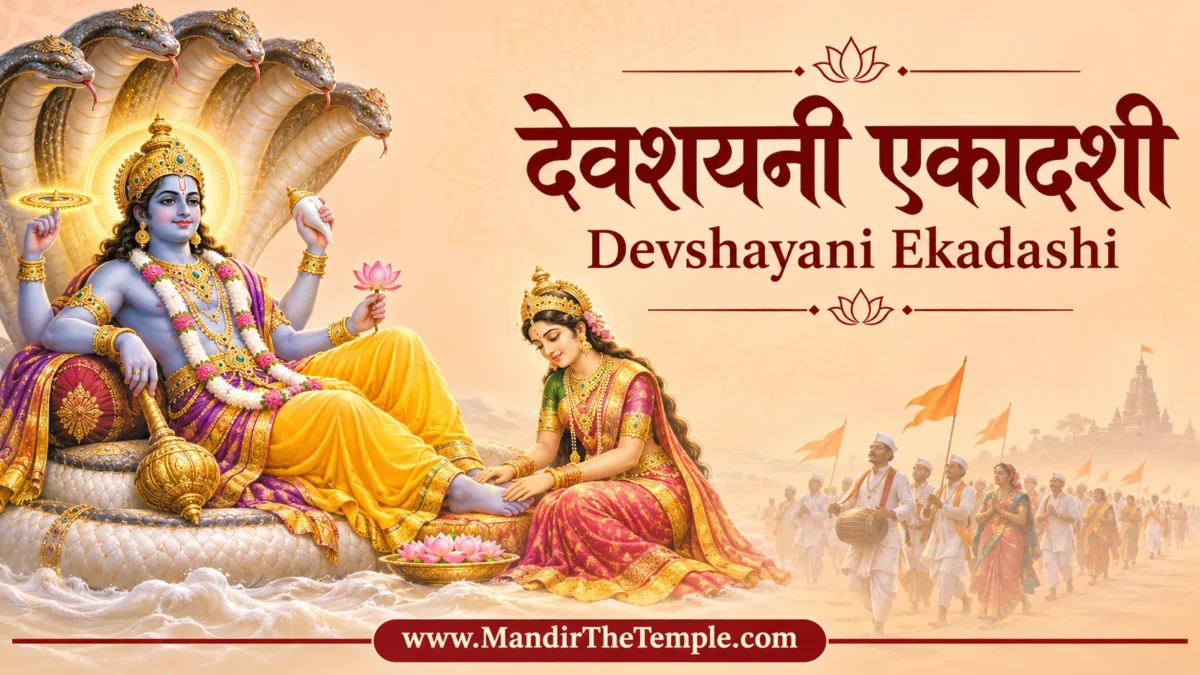
Devshayani Ekadashi is the Ekadashi of Ashadha Shukla Paksha, also known as Harishayani Ekadashi, Padma Ekadashi and Ashadhi Ekadashi. By tradition, on this day Lord Vishnu enters yoga nidra (yogic sleep) on the serpent Sheshnag in the Kshirsagar, the ocean of milk. That is why it is called the day of “Dev” (God) and “shayan” (rest).
Chaturmas, the four sacred months, begins with Devshayani Ekadashi. During this time weddings and other mangalik (auspicious) ceremonies are usually postponed, and the focus shifts to devotion, japa, self-restraint and service. The four months end on Devuthani Ekadashi of Kartik Shukla Paksha, when the Lord wakes. In Maharashtra the same day is Ashadhi Ekadashi, the biggest festival of Lord Vitthal of Pandharpur and the goal of the famous Wari pilgrimage.
When is Devshayani Ekadashi in 2027? Date, Tithi and Parana Time
Quick answer: Devshayani Ekadashi 2026 (25 July) has passed. The next Devshayani Ekadashi is on Wednesday, 14 July 2027. As per the New Delhi panchang, Ekadashi tithi runs from 12:08 PM on 13 July 2027 to 1:10 PM on 14 July, and parana can be done on the morning of 15 July 2027, roughly between 5:33 AM and 8:19 AM.
Next Devshayani Ekadashi
Devshayani Ekadashi 2027
14 July 2027, Wednesday 255 days to go
- Month and paksha
- Ashadha Shukla
- Ekadashi tithi
- 13 Jul 12:10 – 14 Jul 13:12
- Parana (breaking the fast)
- 15 Jul, 05:33 – 08:18
| Year | Fasting date | Ekadashi tithi | Parana |
|---|---|---|---|
| 2026 | 25 July 2026, Saturday | 24 Jul 09:14 – 25 Jul 11:36 | 26 Jul, 05:39 – 08:22 |
| 2027 | 14 July 2027, Wednesday | 13 Jul 12:10 – 14 Jul 13:12 | 15 Jul, 05:33 – 08:18 |
| 2028 | 2 July 2028, Sunday | 2 Jul 01:16 – 3 Jul 00:06 | 3 Jul, 05:54 – 08:14 |
| 2029 | 21 July 2029, Saturday | 21 Jul 02:15 – 22 Jul 00:17 | 22 Jul, 05:50 – 08:21 |
Dates follow the Smarta tradition by sunrise in the selected city (Delhi) and move forward automatically every year. Choose your city above for local timings. Times are approximate; check your local panchang.
Check the table above for the fasting date and parana time in your city. Sunrise differs by city, so the parana window shifts slightly; future years update automatically.
Sometimes Ekadashi tithi stretches over two days. Householders (Smarta) then fast on the first day and Vaishnava devotees on the second, and the table shows both days separately.
Meaning and Other Names of Devshayani Ekadashi
What “Devshayani” means
“Devshayani” joins two words: “Dev”, meaning God, and “shayan”, meaning sleep or rest. The belief is that from this Ekadashi Lord Vishnu rests in yoga nidra for four months, so it is also called “Harishayani”, the sleep of Hari.
This is not ordinary sleep: yoga nidra is a deep meditative state in which the Lord rests in his own nature.
Other names
- Harishayani Ekadashi: because Hari goes to sleep.
- Padma Ekadashi: the name Rishi Angira uses in the katha. Note that some panchangs also call Parivartini Ekadashi of Bhadrapada Shukla “Padma Ekadashi”.
- Ashadhi Ekadashi: because it falls in Ashadha; the most common name in Maharashtra.
- Shayani Ekadashi: the name Lord Krishna uses in older katha texts.
- Toli (Tholi) Ekadashi: in Andhra Pradesh and Telangana. “Tholi” means “first” in Telugu, as it is seen as the first Ekadashi of the rains and of Chaturmas. It is also called Pedda Ekadashi, “the big Ekadashi”.
Month in the Purnimanta and Amanta calendars
Because it is a Shukla Paksha Ekadashi, it is called Ashadha Shukla Ekadashi in both the North Indian Purnimanta calendar and the Amanta calendar used in the South and West. Month names for the bright fortnight are the same in both systems. It usually falls between late June and July, after Yogini Ekadashi (Ashadha Krishna) and before Kamika Ekadashi (Shravana Krishna).
Significance of Devshayani Ekadashi
Religious significance
Among the twenty-four Ekadashis of the year, Devshayani holds a special place because Chaturmas begins on it. In the katha, Lord Krishna calls this vrat a remover of sins that grants heaven and liberation, and says that worshipping Vishnu on this day carries the merit of worshipping all three worlds.
Devotees put the Lord to rest and take a vow for the next four months, so it is the start of a four-month sadhana.
Spiritual message
The katha also carries a message of compassion and justice. Even to save his suffering people, King Mandhata refused to take an innocent life. He chose the path of devotion, and that is where the answer came from.
Mention in the Puranas
By tradition, the katha is a dialogue between Lord Krishna and Yudhishthira, inside which Lord Brahma tells the story to Narada Muni. Sources link it to different Puranas: ISKCON and Vaishnava sources name the Bhavishya Uttara Purana, some Hindi katha texts the Brahma Vaivarta Purana, and some panchangs the Padma Purana. The core story is the same everywhere: King Mandhata, a three-year drought, Rishi Angira’s advice and rain after the fast.
Vishnu’s Yoga Nidra: Kshirsagar and Sheshnag
Lord Vishnu’s well-known “Sheshashayi” form shows him reclining on the coils of Sheshnag in the ocean of milk, a lotus rising from his navel and Goddess Lakshmi at his feet. Devotees meditate on this form on Devshayani Ekadashi. The shloka “Shantakaram Bhujagashayanam” itself calls him “bhujaga-shayana”, the one who rests on a serpent.
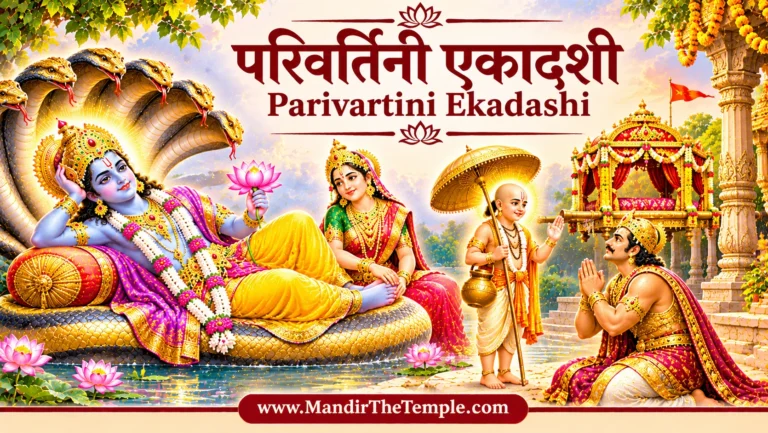
The belief is that the Lord sleeps on Ashadha Shukla Ekadashi, turns on his side on Parivartini Ekadashi of Bhadrapada Shukla, and wakes on Devuthani Ekadashi of Kartik Shukla. Together these three Ekadashis tell the whole story of Chaturmas.
Devshayani Ekadashi Vrat Katha
Yudhishthira’s question
Dharmaraj Yudhishthira once asked Lord Krishna, “O Keshava, what is the name of the Ekadashi of Ashadha Shukla Paksha? How is it observed, and which deity is worshipped on that day? Please tell me in detail.”
Lord Krishna replied, “O King, the story of this Ekadashi is the one Lord Brahma once told Devarshi Narada. Listen carefully.” Narada had asked Brahma about this very Ekadashi, and Brahma said its fast is very dear to Lord Vishnu before telling the story.
Mandhata, the emperor of Satya Yuga
In Satya Yuga there lived a chakravarti emperor named Mandhata, of the Suryavansha (Ikshvaku dynasty). Truthful and mighty, he cared for his subjects like his own children, and his kingdom had never known famine.
Three years of drought
Then, for three years in a row, no rain fell in his kingdom. The fields dried up, grain ran out and a terrible famine set in. Even yajnas and vrats began to decline.
The suffering people came to the king and said, “Maharaj, the whole world depends on rain. Without rain there is no grain, and without grain your people cannot survive. Please find a way.”
Deeply troubled, King Mandhata wondered what sin of his his people were paying for, and set out into the forest with some of his men to find the cause and a remedy.
At the ashram of Rishi Angira
The king reached the ashram of Rishi Angira, a mind-born son of Brahma, bowed to him and explained why he had come. “O sage, I rule by dharma, yet for three years no rain has fallen and my people are suffering. I do not know why. Please remove my doubt and show me a remedy.”
The sage’s answer and the king’s choice
Speaking according to the beliefs of that age, Rishi Angira said that in Satya Yuga only Brahmins were entitled to perform tapasya, yet a Shudra was performing austerities in the king’s realm. This breach, he said, had stopped the rain, and the famine would not end while that man lived. As a remedy he told the king to put the ascetic to death.
Humbly but firmly, King Mandhata replied, “O sage, I cannot take the life of an innocent ascetic. He has committed no crime. Please show me another way.” This moment is seen as the heart of the katha. Readers today take the king’s compassion and non-violence as its main message.
The advice to observe Padma Ekadashi
Pleased by the king’s sense of dharma, the sage said, “O King, if you will not do this, then observe with proper rites the fast of the Ekadashi named Padma, in the bright fortnight of Ashadha. By its power rain will fall in your kingdom and your people will be happy.”
The fruit of the fast
The king returned to his capital and kept the Ashadha Shukla Ekadashi fast with full faith, together with his subjects of all four varnas. By the power of the fast, heavy rain fell, the land turned green again and the famine ended. The kingdom became prosperous and happy once more.
The glory of the katha
Lord Krishna told Yudhishthira that this fast destroys all sins and that even reading or hearing its katha brings merit. He added that from this day Lord Vishnu sleeps for four months, so during these months one should practise dharma, restraint and devotion with special care. By tradition, the merit of those who keep a night vigil singing the Lord’s names is said to be beyond counting.
Variation in the texts: in most Hindi texts the listener is Yudhishthira, while some sources have Krishna telling the story to Arjuna. Brahma, Narada, King Mandhata and Rishi Angira are the same in every version.
The King Bali and Vamana Connection (Belief)
A popular belief links this day with King Bali and Lord Vamana. Bali, the powerful and generous asura king, had grown proud of his might. Lord Vishnu came as Vamana, a dwarf Brahmin, and asked him for three steps of land.
With the first step the Lord covered the earth and all directions, and with the second, heaven. With nothing left for the third, Bali offered his own head. Pleased by his surrender, the Lord made him king of Patala and offered him a boon. Bali asked that the Lord always stay in his palace.
Bound by his word, the Lord stayed in Patala, and Goddess Lakshmi grew worried. She made Bali her brother and asked him to release the Lord from his promise. The belief is that ever since, the Lord spends four months each year with Bali, and this is Chaturmas. Some katha texts say the Lord dwells in Bali’s realm and also rests in yoga nidra on Sheshnag during this time.
This is a folk belief built on the Vamana avatar story; the main vrat katha remains that of King Mandhata.
Chaturmas Begins on Devshayani Ekadashi
What is Chaturmas?
“Chaturmas” means four months: Shravana, Bhadrapada, Ashvin and Kartik. It runs from Ashadha Shukla Ekadashi (Devshayani) to Kartik Shukla Ekadashi (Devuthani or Prabodhini). In a year with an Adhik Maas it lasts longer. As travel was hard in the rains, sadhus traditionally stayed in one place for sadhana and discourses.
Which mangalik ceremonies are avoided?
The belief is that new auspicious undertakings should not begin while the Lord rests. So these are usually postponed for the four months:
- Vivah (weddings) and engagements
- Griha pravesh (housewarming)
- Mundan (first haircut ceremony)
- Yajnopavit (sacred thread ceremony)
- Starting a new home or other major new undertakings for which a muhurat is usually sought
These resume after Devuthani Ekadashi, and in many places the wedding season opens with Tulsi Vivah. Daily puja, festivals, fasts and charity carry on as usual. For a specific muhurat, ask your family priest or check a panchang.
What to do in Chaturmas
- Chant “Om Namo Bhagavate Vasudevaya” or recite the Vishnu Sahasranama daily.
- Offer a lamp (deep daan) in the evening and care for the Tulsi plant.
- Keep to sattvic food, restraint and brahmacharya.
- Some devotees vow to sleep on the floor and eat from palash leaf plates. The elderly, pregnant women and the sick are considered exempt from such strict rules.
The month-wise food tradition
Many families give up one food in each month of Chaturmas. The common practice is:
| Month | Traditionally given up |
|---|---|
| Shravana | Green leafy vegetables (saag) |
| Bhadrapada | Curd and buttermilk |
| Ashvin | Milk |
| Kartik | Urad dal and foods made from it |
Not every family follows this, and many devotees instead give up one favourite food for all four months. If you have a health condition or take regular medicines, speak to your doctor before changing your diet.
How to take the Chaturmas sankalp
- After the Devshayani puja, hold water and akshat in your hand before Lord Vishnu.
- Decide what you will keep for four months: a daily mala of japa, one chapter of the Gita, giving up one item, or weekly charity.
- Pray for the strength to keep it, and release the water onto the ground. Keep the vow small and practical.
Ashadhi Ekadashi and the Pandharpur Wari (Maharashtra)
In Maharashtra, Devshayani Ekadashi is Ashadhi Ekadashi, the greatest festival of the Vitthal-Rukmini temple in Pandharpur (Solapur district). The Warkari tradition worships Vitthal (Vithoba) as a form of Krishna, that is Vishnu, and Rukmini (Rakhumai) as a form of Lakshmi.
What is the Wari?
“Wari” means a pilgrimage made regularly. Before Ashadhi Ekadashi, lakhs of Warkaris walk to Pandharpur over nearly three weeks. The tradition is said to be about eight hundred years old, and many of the pilgrims are farmers and rural families.
Palkhis and dindis
The two main palkhis carry the padukas (sandals) of Sant Dnyaneshwar from Alandi and Sant Tukaram from Dehu, both in Pune district. Pilgrims walk in groups called dindis, singing abhangs and calling out “Jai Hari Vitthal” and “Ram Krishna Hari”.
On the way, the “ringan” sees a horse run through a circle of pilgrims. Warkaris wear a tulsi mala, and the abhangs of Sants Dnyaneshwar, Namdev, Eknath, Chokhamela and Tukaram are the soul of the journey.
Ashadhi Ekadashi in Pandharpur
On Ekadashi, devotees bathe in the Chandrabhaga river, walk the pradakshina of the town and take darshan of Vitthal; the temple stays open almost round the clock. By tradition, the Chief Minister of Maharashtra and spouse perform the official mahapuja of Lord Vitthal on this day. Others visit a local Vitthal temple or worship at home. A second large yatra takes place on Kartiki Ekadashi.
Devshayani Ekadashi Puja Vidhi (Step by Step)
Dashami (the day before)
- Eat a light sattvic meal before sunset. Avoid onion, garlic, meat, alcohol and tamasic food.
- Clean the house and puja space, and gather the samagri a day ahead.
Ekadashi morning and sankalp
- Wake in Brahma muhurat or before sunrise, bathe and wear clean, preferably yellow, clothes.
- Place a chowki with a yellow cloth and set up an idol or picture of Lord Vishnu, ideally in his Sheshashayi form.
- Holding water, akshat and a flower, take the sankalp, saying your name, gotra and type of fast (nirjala, phalahar or one meal). You may recite the sankalp mantra given below.
Worship of Lord Vishnu
- Bathe the Lord with water or panchamrit, then with clean water, and dress him.
- Offer yellow chandan, akshat, yellow flowers and tulsi leaves. Pick tulsi a day earlier, since plucking it on Ekadashi is avoided.
- Light incense and a ghee lamp, and offer fruit, sweets or panchamrit with a tulsi leaf as bhog.
- Chant “Om Namo Bhagavate Vasudevaya” 108 times and recite the Vishnu Sahasranama.
- Read or listen to the vrat katha, then sing Om Jai Jagdish Hare and the Ekadashi Mata Ki Aarti.
Putting the Lord to rest (shayan)
- In many homes and temples a small bed is prepared for the Lord with a clean cloth, pillow and flowers.
- After the evening or night puja, lay the idol gently on the bed, or offer the bhava of shayan before the picture.
- Recite the shayan mantra “Supte tvayi Jagannatha…” and pray that his grace stays on the world while he rests. Then take your Chaturmas vow.
Through the day, remember the Lord and avoid anger and gossip. In the evening do aarti and place a lamp near the Tulsi. If you can, keep a night jagran with bhajan and kirtan.
Dwadashi and parana
- On Dwadashi morning, bathe and worship the Lord, and give food, grain or dakshina to a Brahmin, sadhu or someone in need.
- Within the parana window in the table above, break the fast with tulsi and water offered to the Lord, then eat a light sattvic meal.
Puja Samagri List
- Idol or picture of Lord Vishnu (Sheshashayi form if possible)
- Chowki, yellow cloth, Gangajal and kalash
- Panchamrit (milk, curd, ghee, honey, sugar)
- Yellow chandan, roli, akshat (whole rice for puja)
- Yellow flowers and a garland
- Tulsi leaves (picked a day earlier)
- Incense, ghee lamp, camphor
- Fruit and sweets for bhog
- A small bed, clean cloth and pillow for the Lord (if doing shayan)
- Vrat katha book, Vishnu Sahasranama, tulsi mala
Devshayani Ekadashi Mantras
Faith and focus matter most in japa. Chant one or more of these as suits you; a tulsi mala is considered auspicious.
1. Dvadashakshara mantra
ॐ नमो भगवते वासुदेवाय॥
(Om Namo Bhagavate Vasudevaya) Meaning: Salutations to Lord Vasudeva (Vishnu), who dwells in all beings. This twelve-syllable mantra is the one most chanted on Ekadashi, often 108 times.
2. Hari shayan mantra (special to Devshayani)
सुप्ते त्वयि जगन्नाथ जगत्सुप्तं भवेदिदम्। विबुद्धे त्वयि बुध्येत जगत्सर्वं चराचरम्॥
(Supte tvayi Jagannatha jagat suptam bhaved idam, vibuddhe tvayi budhyeta jagat sarvam characharam) Meaning: O Lord of the universe, when you sleep this whole world sleeps, and when you wake, all beings, moving and unmoving, awaken. It is recited while putting the Lord to rest.
3. Vrat sankalp mantra
सत्यस्थः सत्यसंकल्पः सत्यवित् सत्यदस्तथा। धर्मो धर्मी च कर्मी च सर्वकर्मविवर्जितः॥ कर्मकर्ता च कर्मैव क्रिया कार्यं तथैव च। श्रीपतिर्नृपतिः श्रीमान् सर्वस्यपतिरूर्जितः॥
Meaning: Vishnu is established in truth, true in resolve, knower and giver of truth. He is dharma itself and its upholder, the doer who is yet beyond all action. He is the doer, the deed and the act; the lord of Lakshmi, the sovereign, the glorious master of all.
4. Vishnu dhyana mantra
शान्ताकारं भुजगशयनं पद्मनाभं सुरेशं, विश्वाधारं गगनसदृशं मेघवर्णं शुभाङ्गम्। लक्ष्मीकान्तं कमलनयनं योगिभिर्ध्यानगम्यं, वन्दे विष्णुं भवभयहरं सर्वलोकैकनाथम्॥
Meaning: I bow to Lord Vishnu, peaceful in form, resting on the serpent, lotus-naveled lord of the gods, support of the universe, dark as a rain cloud, beloved of Lakshmi, lotus-eyed, reached by yogis in meditation, remover of worldly fear and sole lord of all worlds.
5. Vishnu Gayatri mantra
ॐ नारायणाय विद्महे वासुदेवाय धीमहि। तन्नो विष्णुः प्रचोदयात्॥
Meaning: We contemplate Lord Narayana and meditate on Vasudeva; may Lord Vishnu guide our intellect on the right path.
What to Eat and Avoid in the Devshayani Ekadashi Fast
What you can eat
- Seasonal fruits such as banana, apple, papaya and guava
- Milk, curd, buttermilk and paneer (if your tradition allows)
- Sabudana, kuttu (buckwheat) flour, singhara flour, rajgira
- Potato, sweet potato, arbi, pumpkin
- Peanuts, makhana, dry fruits
- Sendha namak (rock salt), black pepper, cumin
- Coconut water, lemon water, plain water
What to avoid
- Rice and anything made from it (the most strictly avoided food on Ekadashi)
- All grains such as wheat, barley and maize
- Dals and beans
- Ordinary table salt
- Onion, garlic, meat, eggs, alcohol, tobacco
- Heavy, deep-fried food
Nirjala fast
A nirjala fast means no food and no water for the whole day. It is the hardest form and only for people in good health. July heat and humidity can dehydrate the body quickly, so drink water at once if you feel dizzy, weak or uneasy. The Lord sees devotion; hurting the body is not the aim of a vrat.
Phalahar fast
Most devotees keep a phalahar fast, eating fruit, milk and vrat foods once or twice and drinking water. It is more practical for working people, students and the elderly.
One meal (ekabhukta)
Some people eat one sattvic, grain-free meal in the day. Those who cannot fully fast for health reasons can keep the vrat this way with equal faith.
Health caution: if you have diabetes, blood pressure, kidney or heart problems, are pregnant or breastfeeding, are elderly or take regular medicines, do not keep a strict or nirjala fast. Consult your doctor before choosing any form of fasting, and never stop medicines without medical advice.
Devshayani Ekadashi Parana: When and How to Break the Fast
Breaking the Ekadashi fast on the next day, Dwadashi, is called parana. The correct time for your city is in the table above.
- Within Dwadashi: parana should be done before Dwadashi tithi ends.
- Not during Hari Vasara: the first quarter of Dwadashi is called Hari Vasara; wait for it to end.
- Morning is best: early morning is the preferred time, and midday parana is usually avoided.
- Smarta and Vaishnava: when the fast falls on two days, the parana times also differ. Follow the row for your tradition in the table.
After puja and daan, break the fast with tulsi and water offered to the Lord, then eat a light sattvic meal.
Dos and Don’ts on Devshayani Ekadashi
Do
- Worship Lord Vishnu with yellow flowers and tulsi.
- Read or listen to King Mandhata’s katha with your family.
- Put the Lord to rest and recite the shayan mantra.
- Take a small, practical vow for Chaturmas.
- Give an umbrella, grain, clothes or food in charity, keeping the rainy season in mind.
Don’t
- Don’t eat rice or grains.
- Don’t pluck tulsi leaves on Ekadashi.
- Avoid anger, lies, gossip and harsh words.
- Avoid meat, alcohol, onion, garlic and tamasic food.
- Don’t fix muhurats for weddings, griha pravesh or similar new ceremonies from this day.
Devshayani Ekadashi Myths and Reality (Myth vs Reality)
Myth: The Lord sleeps for four months, so worship during this time bears no fruit.
Reality: Tradition says the opposite. In the katha Lord Krishna asks for special devotion and restraint in these months. Devotees see yoga nidra as deep meditation, not indifference, and festivals like Janmashtami, Navratri and Diwali all fall in Chaturmas.
Myth: Nothing auspicious can happen in Chaturmas, not even puja or festivals.
Reality: Tradition mainly postpones samskaras like weddings, griha pravesh, mundan and the sacred thread ceremony. Daily puja, fasts, festivals, charity, service and study all continue. If in doubt, ask your priest rather than stopping necessary work out of fear.
Myth: Keeping this fast will surely bring rain.
Reality: In King Mandhata’s katha rain follows the fast, which is why farming families pray for good rains on this day. That is a matter of faith and prayer. Weather follows nature’s laws, so keep the fast as a prayer, not as a forecast.
Myth: The katha teaches that some people have no right to devotion or tapasya.
Reality: The sage voices the belief of his age, but the turning point of the story is the king’s refusal. Mandhata will not punish an innocent ascetic, and the fast is kept by people of all four varnas together, after which the rain comes. In the same katha text the Lord says that whoever keeps this vrat, of any varna, is dear to him. The door of bhakti is open to all.
Myth: Without a nirjala fast, Devshayani Ekadashi gives no merit.
Reality: Tradition asks you to fast according to your capacity. A phalahar or one-meal fast kept with faith is considered just as meaningful. The sick, pregnant women, the elderly and people on medicines should decide the form of fasting only with a doctor’s advice.
Benefits of Devshayani Ekadashi (Religious Belief)
These are matters of religious belief, not guarantees.
- Freedom from sins: by the katha, the fast is believed to remove sins committed knowingly or unknowingly.
- Fulfilment of wishes: some katha texts call it a vrat that fulfils all wishes.
- A good start to Chaturmas: beginning four months of sadhana with puja and a vow builds discipline.
- Prayer for prosperity: because of Mandhata’s story, devotees pray for good rains, food and happiness at home.
- Liberation: tradition describes this Ekadashi as granting heaven and moksha.
Related Ekadashi and Readings
Just before Devshayani comes Yogini Ekadashi of Ashadha Krishna Paksha, the last Ekadashi before Chaturmas. After it comes Kamika Ekadashi of Shravana Krishna Paksha. Four months later, on Devuthani Ekadashi of Kartik Shukla, the Lord wakes and Chaturmas ends, along with the festival of Tulsi Vivah. See the dates of every Ekadashi of the year on our Ekadashi Kab Hai page.
For the day’s puja, also read the Om Jai Jagdish Hare Aarti, Ekadashi Mata Ki Aarti and Tulsi Mata Ki Aarti. For daily tithi and muhurat, see the Daily Panchang, and for all aartis in one place, download the Aarti Sangrah PDF.
Devshayani Ekadashi teaches that devotion is not a one-day celebration but restraint and love kept up over a long time. Like King Mandhata, hold on to compassion and dharma even in hard times, and keep one small good vow sincerely through these four months. May Shri Hari, even in his yoga nidra, bless you and your whole family. Om Namo Bhagavate Vasudevaya.
Frequently asked questions
When is Devshayani Ekadashi in 2027?
The 2027 date, Ekadashi tithi timings and parana window are given in the “When is” section at the top of this page. For your city and for future years, see the date table on this page.
In which month and paksha does Devshayani Ekadashi fall?
It is the Ekadashi of Ashadha Shukla Paksha. Being in the bright fortnight, it is called Ashadha Shukla Ekadashi in both the Purnimanta and Amanta calendars. It usually falls between late June and July.
Why is it called Devshayani Ekadashi?
By tradition, on this day Lord Vishnu enters four months of yoga nidra on Sheshnag in the Kshirsagar. “Dev” means God and “shayan” means rest, so it is called Devshayani or Harishayani Ekadashi.
What are the other names of Devshayani Ekadashi?
It is also called Harishayani, Padma, Ashadhi and Shayani Ekadashi. In Andhra Pradesh and Telangana it is Toli (Tholi) Ekadashi, meaning the “first” Ekadashi of the rainy season.
What is the Devshayani Ekadashi vrat katha?
In Satya Yuga, King Mandhata’s kingdom had no rain for three years. On Rishi Angira’s advice the king and his people kept the Ashadha Shukla (Padma) Ekadashi fast, after which heavy rain fell and the famine ended. Lord Krishna told this story to Yudhishthira, as Brahma had once told it to Narada.
How long does Chaturmas last after Devshayani Ekadashi?
Chaturmas begins on Devshayani Ekadashi and ends on Devuthani (Prabodhini) Ekadashi of Kartik Shukla, covering Shravana, Bhadrapada, Ashvin and Kartik. In a year with an Adhik Maas it is longer.
What should not be done during Chaturmas?
Tradition usually postpones weddings, engagements, griha pravesh, mundan and the sacred thread ceremony for these four months. Daily puja, fasts, festivals and charity continue as usual.
Which mantra should be chanted on Devshayani Ekadashi?
“Om Namo Bhagavate Vasudevaya” 108 times is the most common. While putting the Lord to rest, the shayan mantra “Supte tvayi Jagannatha jagat suptam bhaved idam…” is recited. Both are given with meanings in the mantra section of this page.
Can we drink water during the Devshayani Ekadashi fast?
Yes, water is allowed in phalahar and one-meal fasts. Only the nirjala fast excludes water, and it should be kept only by people in good health. Drink water at once if you feel dizzy or weak.
Can we eat rice on Devshayani Ekadashi?
No. Rice and anything made from it are avoided on Ekadashi, along with wheat, dals and other grains.
What can be eaten in the Devshayani Ekadashi fast?
Fruit, milk, curd, sabudana, kuttu or singhara flour, potato, sweet potato, makhana, peanuts and food made with sendha namak. Avoid onion, garlic and ordinary salt.
When should the Devshayani Ekadashi parana be done?
On the next day, during Dwadashi tithi, after sunrise and once Hari Vasara is over, and before Dwadashi ends. See the table on this page for the exact window in your city.
What is the difference between Smarta and Vaishnava Devshayani Ekadashi?
When Ekadashi tithi spans two days, householders (Smarta) fast on the first day and Vaishnava devotees on the second. When both fall on the same day, everyone fasts together. The table on this page shows both days when they differ.
What is Ashadhi Ekadashi and the Pandharpur Wari?
In Maharashtra, Devshayani Ekadashi is called Ashadhi Ekadashi. Before it, lakhs of Warkaris walk for nearly three weeks with the palkhis of Sant Dnyaneshwar from Alandi and Sant Tukaram from Dehu to the Vitthal-Rukmini temple in Pandharpur.
How is Devshayani Ekadashi connected with King Bali?
By popular belief, Lord Vishnu was bound by his promise to Bali in the Vamana avatar to live in Patala. After Goddess Lakshmi’s request, it is believed he stays with Bali four months each year, which is Chaturmas. The main vrat katha remains that of King Mandhata.
Can pregnant women and the elderly keep the Devshayani Ekadashi fast?
Pregnant women, the elderly, people with diabetes or other conditions and those on medicines should not keep a nirjala or strict fast. With a doctor’s advice they can keep a phalahar or one-meal fast, or simply do puja, japa and listen to the katha.
What if the Devshayani Ekadashi fast is broken by mistake?
Don’t panic. Sincerely ask the Lord’s forgiveness, chant “Om Namo Bhagavate Vasudevaya” and spend the rest of the day with restraint. The Lord looks at devotion, so there is no need for fear.
Which Ekadashi comes after Devshayani Ekadashi?
Kamika Ekadashi of Shravana Krishna Paksha comes next. Yogini Ekadashi of Ashadha Krishna comes just before Devshayani, and Chaturmas ends on Devuthani Ekadashi of Kartik Shukla.