
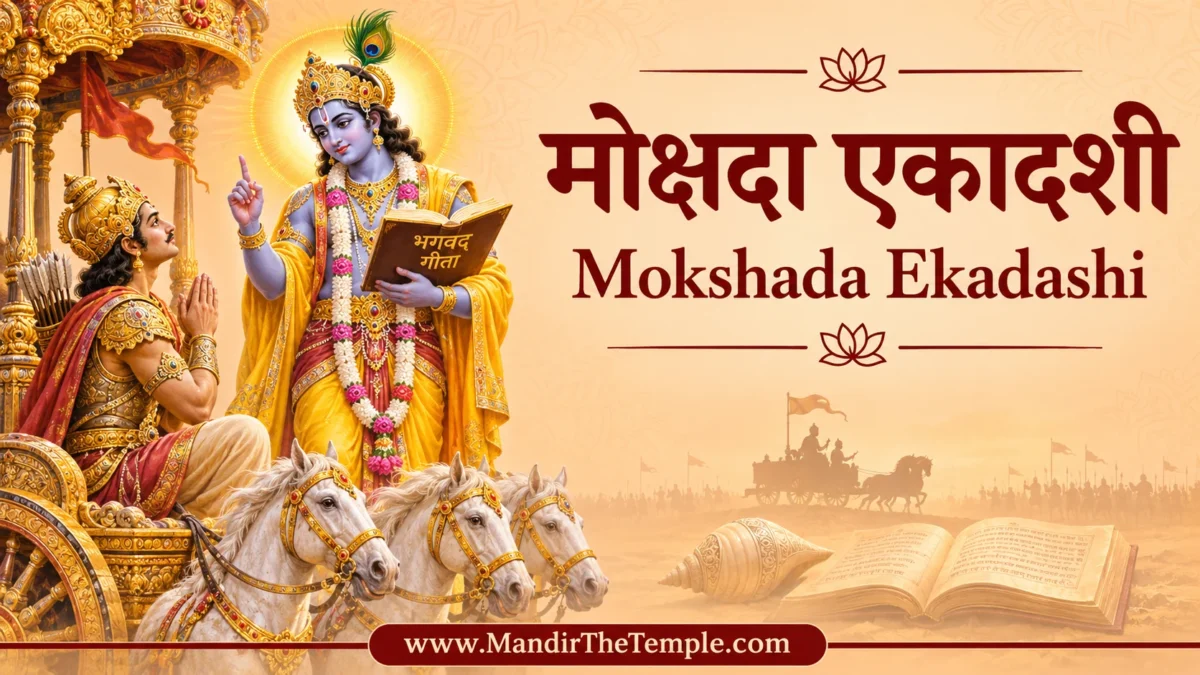
Mokshada Ekadashi (मोक्षदा एकादशी) is the Ekadashi of the bright fortnight (Shukla Paksha) of the month of Margashirsha, also called Aghan, and it is one of the most sacred fasts dedicated to Lord Vishnu. The name literally means “the giver of moksha” (liberation). By tradition, this fast is kept not only for one’s own spiritual welfare but also for the peace and liberation of one’s ancestors (pitru).
The day carries a second, equally important identity: it is celebrated as Gita Jayanti, the day on which Lord Krishna is believed to have spoken the Bhagavad Gita to Arjuna on the battlefield of Kurukshetra. So Mokshada Ekadashi brings together three things — fasting, Vishnu worship and the reading of the Gita.
In South India, when this Ekadashi falls within the solar month of Dhanurmasa (Margazhi), it is also observed as Vaikuntha Ekadashi. Below you will find the date and parana time, the vrat katha, a step-by-step puja vidhi, mantras, how to read the Gita on this day, charity for ancestors, and a clear explanation of the Vaikuntha Ekadashi connection.
Mokshada Ekadashi Date 2026: Tithi and Parana Time
Quick answer: Mokshada Ekadashi 2026 will be observed on Sunday, 20 December 2026. As per the New Delhi panchang, Ekadashi tithi begins at 10:09 PM on 19 December and ends at 8:14 PM on 20 December, and parana (breaking the fast) can be done on 21 December between 7:10 AM and 9:13 AM. Gita Jayanti falls on the same day.
Next Mokshada Ekadashi
Mokshada Ekadashi 2026
20 December 2026, Sunday 49 days to go
- Month and paksha
- Margashirsha Shukla
- Ekadashi tithi
- 19 Dec 22:11 – 20 Dec 20:16
- Parana (breaking the fast)
- 21 Dec, 07:09 – 09:13
| Year | Fasting date | Ekadashi tithi | Parana |
|---|---|---|---|
| 2026 | 20 December 2026, Sunday | 19 Dec 22:11 – 20 Dec 20:16 | 21 Dec, 07:09 – 09:13 |
| 2027 | 9 December 2027, Thursday | 9 Dec 03:00 – 10 Dec 03:21 | 10 Dec, 13:15 – 15:20 |
| 2028 | 27 November 2028, Monday | 27 Nov 00:00 – 28 Nov 02:18 | 28 Nov, 08:47 – 09:00 |
| 2029 | 16 December 2029, Sunday | 15 Dec 16:41 – 16 Dec 19:19 | 17 Dec, 07:07 – 09:11 |
Dates follow the Smarta tradition by sunrise in the selected city (Delhi) and move forward automatically every year. Choose your city above for local timings. Times are approximate; check your local panchang.
The table above shows the date and parana window for your city for this year and the coming years.
Smarta vs Vaishnava: When the Ekadashi tithi spans two days, householders (Smarta) usually fast on the first day and Vaishnava traditions such as ISKCON on the second. In 2026, the New Delhi panchang lists both traditions on 20 December, but please check the table for your own city.
Mokshada Ekadashi Meaning and Other Names
“Mokshada” combines two Sanskrit words — “moksha”, freedom from the cycle of birth and death, and “da”, the one who gives. So Mokshada Ekadashi means “the Ekadashi that grants liberation”. In the katha, the father of King Vaikhanasa is freed from hell through the merit of this fast, which makes the name especially fitting.
Other names of Mokshada Ekadashi
- Margashirsha Shukla Ekadashi — the name based on the lunar date.
- Aghan Ekadashi — in North India, Margashirsha is commonly called Aghan.
- Gita Ekadashi / Gita Jayanti — because the Gita was spoken on this day.
- Vaikuntha Ekadashi / Mukkoti Ekadashi — in South India, when the date falls in Dhanurmasa (Margazhi).
- Dhanurmasa Ekadashi — in some traditions, when it falls after Dhanu Sankranti.
- Maun Ekadashi (Maun Agiyaras) — in the Jain tradition, Margashirsha Shukla Ekadashi is a special day of silence and fasting.
Which month in Purnimanta and Amanta calendars?
North India follows the Purnimanta calendar (months end on the full moon), while South and West India follow the Amanta calendar (months end on the new moon). The good news is that the bright fortnight carries the same month name in both systems. So Mokshada Ekadashi is Margashirsha Shukla Ekadashi everywhere.
It usually falls between late November and December. It comes after Utpanna Ekadashi (Margashirsha Krishna Paksha) and before Saphala Ekadashi (Pausha Krishna Paksha).
Significance of Mokshada Ekadashi
Mokshada Ekadashi is specially linked with three themes — liberation, the welfare of ancestors and spiritual knowledge through the Gita.
Religious significance
The month of Margashirsha is considered very dear to the Lord. In the Bhagavad Gita (10.35) Krishna says “masanam margashirsho’ham” — “among months, I am Margashirsha”. A fast, japa and charity on the bright Ekadashi of this beloved month are therefore regarded as especially meritorious.
It is believed that keeping this fast with devotion, worshipping Lord Vishnu or Krishna, and dedicating the merit of the fast to one’s ancestors helps them attain a better state. That is why it is often called “the Ekadashi that liberates the ancestors”.
Spiritual message
The deeper message of Mokshada Ekadashi is that true freedom comes not from ritual alone but from right understanding and selfless action — exactly what the Gita teaches. The fast trains self-control, and reading the Gita brings clarity to the mind.
The story also teaches gratitude: a son treats his father’s suffering as his own and undertakes a spiritual practice for him.
Mention in the Puranas
According to tradition, the glory of Mokshada Ekadashi is described in the Brahmanda Purana, and it also appears in the Ekadashi mahatmya narratives associated with the Padma Purana. In these accounts, Yudhishthira asks Lord Krishna about the Ekadashi of Margashirsha Shukla Paksha, and Krishna narrates the story of King Vaikhanasa.
Mokshada Ekadashi Vrat Katha
Once, Dharmaraja Yudhishthira humbly asked Lord Krishna: “O Keshava, I have heard the glory of Utpanna Ekadashi of the dark fortnight of Margashirsha. Now kindly tell me the name of the Ekadashi of the bright fortnight of this month, how it should be observed and what merit it brings.”
Krishna replied with pleasure: “O King, this Ekadashi is called Mokshada. It destroys sins and grants liberation. On this day Lord Damodara should be worshipped with incense, lamps and offerings. Now listen carefully to an ancient story connected with it.”
King Vaikhanasa’s dream
Long ago there was a beautiful city called Champaka Nagara (some Hindi versions name it Gokul). It was ruled by a righteous king named Vaikhanasa, who cared for his subjects as if they were his own children. Learned brahmins well versed in the four Vedas lived in his kingdom, and the people were happy.
One night the king dreamt that his father was suffering terribly in hell. His father cried out, “My son, I am in great pain here. Please find some way to free me from this hell.” The king woke up deeply disturbed.
In the morning he called the learned brahmins and told them about the dream. “My father is suffering in hell while I enjoy the comforts of a king,” he said. “What use is a son who cannot save his father from suffering? Please tell me a way to free him.”
At the hermitage of Parvata Muni
The brahmins said, “O King, the hermitage of Parvata Muni is close by. He knows the past, present and future. Go to him; he will surely show you a way.”
The king went at once to the hermitage, where many sages and yogis were engaged in austerities. He bowed respectfully to the sage and told him the whole dream.
Parvata Muni closed his eyes and meditated for a while. Through his yogic insight he saw the past deeds of the king’s father. Then he said, “O King, in a previous life your father committed a wrong. He had two wives. Influenced by one of them, he was unjust to the other and refused her rightful request when she came to him in her fertile period wishing for a child. Because of this partiality and neglect of his duty, he is now suffering in hell.”
The remedy: the Mokshada Ekadashi fast
The king pleaded, “O sage, please tell me how my father can be freed from this sin.”
The sage replied, “O King, the Ekadashi of the bright fortnight of Margashirsha is called Mokshada. Observe this fast properly together with your whole family. When the fast is complete, take a formal resolve (sankalpa) and offer its merit to your father. By the power of that merit your father will be released from hell.”
The king bowed to the sage and returned to his palace. When Margashirsha Shukla Ekadashi arrived, he observed the fast with devotion together with his queens, sons and other family members. He worshipped Lord Vishnu through the day, kept a night vigil with devotional singing, and on Dwadashi broke the fast after feeding brahmins and giving charity.
The father’s liberation
After completing the fast, the king took water in his hand and declared, “I offer the entire merit of this fast to my father.” As soon as he did so, auspicious sounds filled the sky. His father, freed from hell, rose in a divine form towards heaven.
As he departed he blessed his son: “My son, may you be blessed.”
Concluding the story, Krishna told Yudhishthira: “O King, whoever observes Mokshada Ekadashi with faith is freed from sins and ultimately attains liberation. There is no other fast greater than this in granting moksha.”
The lesson of the story: our actions affect more than just ourselves, and a sincere spiritual practice — and its merit — can be dedicated to our loved ones. After the katha, it is customary to sing the Ekadashi Mata Ki Aarti.
Mokshada Ekadashi Puja Vidhi (Step by Step)
This method is for ordinary householders; if your family or sampradaya has its own tradition, follow that. Devotion matters more than a perfect set of items.
Preparation on Dashami (the day before)
- On Dashami, eat a single simple sattvic meal before sunset. Avoid rice, masoor dal, onion, garlic and non-vegetarian food.
- Observe celibacy that night and keep the next day’s fast in mind.
- Clean the puja area and keep a copy of the Gita, tulsi leaves and puja items ready.
Ekadashi morning and sankalp
- Wake up before sunrise (ideally in Brahma Muhurta), bathe and wear clean clothes, preferably yellow.
- Offer water to the Sun.
- Holding water, rice grains and a flower, take the sankalp: “Today I am keeping the Mokshada Ekadashi fast to please Lord Vishnu and for the welfare of my ancestors.” Say your name and gotra.
- Decide the type of fast according to your capacity — nirjala, phalahar or one meal.
Worship of Lord Vishnu / Krishna
- Spread a yellow cloth on a low stool and place an idol or picture of Lord Vishnu, Krishna or Laddu Gopal. Keep a copy of the Bhagavad Gita beside it.
- Remember Lord Ganesha first, then install a kalash if it is part of your tradition.
- Bathe the deity with Ganga water or clean water, then with panchamrit (milk, curd, ghee, honey and sugar).
- Offer yellow clothes, yellow sandalwood paste, yellow flowers, rice grains and tulsi leaves. Pluck tulsi leaves a day earlier — do not pluck tulsi on Ekadashi.
- Light incense and a lamp and offer fruits, sweets or panchamrit as bhog, always with a tulsi leaf.
- Chant “Om Namo Bhagavate Vasudevaya” at least one round (108 times).
- Read or listen to the Mokshada Ekadashi vrat katha.
- Read the Gita — if not the whole text, at least one chapter (chapters 15 or 18 are popular).
- Finish with the Om Jai Jagdish Hare Aarti and ask forgiveness for any mistakes.
Evening puja and night vigil
- Light the lamp again in the evening and place a ghee lamp near the tulsi plant.
- Recite the Vishnu Sahasranama, read the Gita or sing bhajans.
- Keep a night vigil (jagran) if you can; otherwise sing for some time and then rest.
- Avoid sleeping during the day, which is traditionally discouraged on Ekadashi.
Dwadashi and parana
- On Dwadashi morning, bathe and worship the Lord.
- Offer food or charity to a brahmin, a needy person or a cow.
- Holding water, dedicate the merit of the fast to the Lord and to your ancestors.
- Break the fast within the parana window shown in the table above, with a tulsi leaf or the Lord’s prasad.
Puja Samagri List
- Idol or picture of Lord Vishnu / Krishna / Laddu Gopal
- A copy of the Shrimad Bhagavad Gita
- Low stool (chowki) and yellow cloth
- Ganga water and a copper or brass lota
- Panchamrit (milk, curd, ghee, honey, sugar)
- Tulsi leaves (plucked a day earlier)
- Yellow flowers and a garland
- Yellow sandalwood, roli, turmeric, unbroken rice (akshat)
- Dhoop, incense sticks, camphor
- Ghee lamp and cotton wicks
- Seasonal fruits, bananas, mishri, dry fruits
- Sweets or panjiri for bhog
- Tulsi or sandalwood mala for japa
- Items for charity: grain, warm clothes, blankets or copies of the Gita
Mokshada Ekadashi Mantras
In japa, faith and focus matter more than perfect pronunciation.
1. The twelve-syllable mantra
Om Namo Bhagavate Vasudevaya (ॐ नमो भगवते वासुदेवाय)
Meaning: I bow to Lord Vasudeva (Krishna / Vishnu). This is the most widely chanted Ekadashi mantra; 108 repetitions are considered auspicious.
2. Krishna stuti
Krishnaya Vasudevaya Haraye Paramatmane, Pranatah Kleshanashaya Govindaya Namo Namah
Meaning: Salutations to Krishna, son of Vasudeva, Hari, the Supreme Self — again and again I bow to Govinda, who removes the suffering of those who surrender.
3. The Gita verse of surrender
Sarva-dharman parityajya mam ekam sharanam vraja, aham tvam sarva-papebhyo mokshayishyami ma shuchah (Gita 18.66)
Meaning: Setting aside all other supports, take refuge in Me alone. I will free you from all sins; do not grieve. This verse is especially recited on Mokshada Ekadashi because it speaks of liberation itself.
4. Hare Krishna Mahamantra
Hare Krishna Hare Krishna Krishna Krishna Hare Hare, Hare Rama Hare Rama Rama Rama Hare Hare
Meaning: A chant of the holy names of the Lord. In Vaishnava tradition, devotees chant it as much as possible on Ekadashi.
Gita Jayanti and Mokshada Ekadashi
Mokshada Ekadashi and Gita Jayanti are celebrated on the same day. According to tradition, at the start of the Mahabharata war at Kurukshetra, when Arjuna was overcome by confusion and grief, Krishna gave him the teaching of the Gita — on Margashirsha Shukla Ekadashi.
The Gita has 18 chapters and about 700 verses on the paths of action, devotion and knowledge. Kurukshetra in Haryana hosts a large Gita Mahotsav around this time, and many temples, including ISKCON temples, hold Gita recitations and distribute copies of the Gita.
For a detailed puja method, read our guide on Gita Jayanti Puja Vidhi.
How to Do Gita Path on Mokshada Ekadashi
Reading the Gita is an integral part of this fast. Choose a method that suits your time.
- Complete recitation: read all 18 chapters between morning and evening. Family members can share chapters among themselves.
- One chapter: if time is short, read one chapter. Chapters 12 (Bhakti Yoga), 15 (Purushottama Yoga) and 18 (Moksha Sannyasa Yoga) are popular choices.
- For ancestors: many families read the Gita with a prayer for their ancestors’ peace.
- Reflection: if Sanskrit is difficult, read a translation and reflect on the meaning of a few verses through the day.
Before reading, offer flowers and rice grains to the Gita; afterwards, bow to the Lord and perform aarti.
Charity and Sankalp for Ancestors (Pitru)
Because of the story of King Vaikhanasa, Mokshada Ekadashi is closely linked with the liberation of ancestors. Many people remember their departed parents, grandparents and other forebears and dedicate the merit of their fast to them.
A simple sankalp to dedicate merit
On Dwadashi, before parana, hold water, sesame seeds and a tulsi leaf and pray: “May the merit of the Mokshada Ekadashi fast I have kept with devotion reach my ancestors by Lord Vishnu’s grace, and may they attain peace.” Then pour the water at the root of a plant or the tulsi.
What to donate on Mokshada Ekadashi
- A copy of the Bhagavad Gita — Gita daan is considered special because it is Gita Jayanti.
- Warm clothes and blankets — very useful to those in need in the December cold.
- Grain — uncooked grain, flour or lentils for needy families.
- Sesame and jaggery — many traditions donate sesame on behalf of ancestors.
- Deep daan — lighting a ghee lamp at a temple or near the tulsi.
- Cow service — feeding green fodder or jaggery to a cow.
Note: customs around shraddha, pind daan or tarpan on Ekadashi differ by region, so follow your family tradition or consult a priest. For most householders, the fast, dedication of merit and charity are considered sufficient.
Mokshada Ekadashi and Vaikuntha Ekadashi: The Connection
Vaikuntha Ekadashi is one of the biggest Ekadashis in South India (Tamil Nadu, Andhra Pradesh, Telangana, Karnataka). In Telugu-speaking regions it is also called Mukkoti Ekadashi.
How Vaikuntha Ekadashi is decided
Mokshada Ekadashi is fixed by the lunar month (Margashirsha Shukla), while Vaikuntha Ekadashi is fixed by the solar month. The month when the Sun is in Sagittarius (Dhanu) is called Dhanurmasa — Margazhi in Tamil — and it normally runs from mid-December to mid-January. The Shukla Paksha Ekadashi that falls in this solar month is Vaikuntha Ekadashi.
- If Margashirsha Shukla Ekadashi falls after Dhanu Sankranti, Mokshada Ekadashi and Vaikuntha Ekadashi are the same day.
- If Margashirsha Shukla Ekadashi falls before Dhanu Sankranti, Vaikuntha Ekadashi falls on the next month’s Pausha Shukla Ekadashi, i.e. Pausha Putrada Ekadashi.
- Because of this solar-lunar difference, a Gregorian year can have one, two or occasionally no Vaikuntha Ekadashi.
In 2026, Mokshada Ekadashi falls after Dhanurmasa begins, so South Indian panchangs list Vaikuntha Ekadashi, Mokshada Ekadashi and Gita Jayanti on the same day this year. This alignment can change in other years, so check a local panchang each year.
Vaikuntha Dwara darshan
Vaishnavas believe that the gate of Vaikuntha, Lord Vishnu’s abode, opens on Vaikuntha Ekadashi. In this spirit, devotees pass through the “Paramapada Vasal” (gate of heaven) at the Sri Ranganathaswamy temple in Srirangam and the “Vaikuntha Dwaram” at Tirumala. Srirangam celebrates a festival of about 20 days around it (Pagal Pathu and Ira Pathu).
What to Eat and Avoid in the Mokshada Ekadashi Fast
The core rule of the Ekadashi fast is to give up grains, especially rice. Adapt the general rules below to your family tradition.
Foods you can eat
- Seasonal fruits — banana, apple, papaya, guava, orange and others.
- Milk, curd, buttermilk, paneer, khoya.
- Dry fruits — almonds, cashews, raisins, makhana.
- Kuttu (buckwheat), singhara (water chestnut) or rajgira flour, as per phalahari custom.
- Sabudana, potato, sweet potato, arbi.
- Rock salt (sendha namak), black pepper, cumin.
Foods to avoid
- Rice and anything made from rice.
- Grains like wheat, barley and maize, and all lentils.
- Onion, garlic and non-vegetarian food.
- Regular iodised salt — many people use only rock salt.
- Alcohol, tobacco and any intoxicants.
Nirjala fast
In a nirjala fast, both food and water are given up for the whole day. It is the strictest form and is only for people in good health.
Phalahar fast
Most householders keep a phalahar fast with fruits, milk, nuts and permitted foods, and drink water.
One meal (ekabhukta)
Those who cannot fast completely may eat one phalahari or permitted sattvic meal in the day. Grains and rice are still avoided.
Health caution: if you have diabetes, high or low blood pressure, heart or kidney conditions, are pregnant or breastfeeding, are elderly, or take regular medication, do not keep a strict fast. Consult your doctor, keep a light phalahar fast if advised, and take medicines on time. The scriptures themselves relax fasting rules for children, the elderly and the sick.
Mokshada Ekadashi Parana: When and How to Break the Fast
Parana means breaking the fast; done at the wrong time, the fast is traditionally considered incomplete.
- Within Dwadashi: break the fast after sunrise on the next day and before Dwadashi tithi ends.
- Not during Hari Vasara: the first quarter of Dwadashi is called Hari Vasara. Do not break the fast during this period; wait until it ends.
- Morning is best: early morning (pratahkal) is the preferred time. Avoid madhyahna (midday); if morning is not possible, break it after midday.
- Smarta and Vaishnava: in years when the two traditions fast on different days, the parana day also differs. Check the table for your tradition.
How to do parana
- Bathe, worship Lord Vishnu and offer bhog.
- Give food or charity to a brahmin, a needy person or a cow.
- Dedicate the merit of the fast to the Lord and to your ancestors.
- Break the fast first with a tulsi leaf, water or the Lord’s prasad.
- Then eat a light sattvic meal. Avoid onion, garlic and heavy food even on parana day.
The exact parana window for your city is in the table above. For daily tithis, see our Daily Panchang.
Do’s and Don’ts on Mokshada Ekadashi
Do’s
- Wake before sunrise, bathe and take the sankalp.
- Offer tulsi leaves in the worship of Lord Vishnu / Krishna.
- Read or listen to the Bhagavad Gita.
- Chant “Om Namo Bhagavate Vasudevaya”.
- Remember your ancestors and dedicate the merit of your fast to them.
- Donate warm clothes, grain, a Gita or lamps.
- Break the fast at the correct time.
Don’ts
- Do not eat rice or any grain.
- Do not pluck tulsi leaves on Ekadashi.
- Avoid onion, garlic, meat and alcohol.
- Do not sleep during the day.
- Avoid cutting hair or nails and shaving (a custom in many families).
- Do not force a strict fast if your health does not allow it.
Mokshada Ekadashi Myths vs Reality
Myth: Keeping the Mokshada Ekadashi fast guarantees moksha.
Reality: Tradition describes this fast as leading towards liberation, but that is a matter of faith, not a guarantee. Both the scriptures and the Gita teach that a fast is meaningful when joined with devotion, good conduct and selfless action. One day’s fast is not a substitute for a lifetime of right living.
Myth: Only a son can keep this fast for the ancestors.
Reality: In the katha, King Vaikhanasa kept the fast together with his queens and the whole family. Anyone, man or woman, can keep the Ekadashi fast and dedicate its merit to their ancestors with devotion.
Myth: If you don’t keep a nirjala fast, the fast bears no fruit.
Reality: The tradition describes nirjala, phalahar and one-meal fasts. A fast chosen according to your capacity, kept with sincere devotion, is equally valid. Harming your health is not the goal of dharma.
Myth: Eating something by mistake breaks the fast and brings sin.
Reality: If you eat something by mistake or out of necessity, there is no need to panic. Ask the Lord’s forgiveness, chant “Om Namo Bhagavate Vasudevaya” and complete the rest of the day with discipline. Tradition places intention above rule.
Myth: Mokshada and Vaikuntha Ekadashi are completely separate and never coincide.
Reality: They are fixed by different calendars — Mokshada by the lunar month and Vaikuntha by the solar Dhanurmasa. When Margashirsha Shukla Ekadashi falls in Dhanurmasa, as in 2026, they fall on the same day; otherwise Vaikuntha Ekadashi falls on Pausha Putrada Ekadashi.
Myth: Fasting is a “detox”, so everyone should keep a nirjala fast.
Reality: The aim of the Ekadashi fast is spiritual discipline, not medical treatment. Fasting is not equally safe for every body. People with diabetes, pregnant women, the elderly and those on medication should decide the form of the fast with their doctor’s advice.
Benefits of Mokshada Ekadashi (Religious Beliefs)
These benefits are based on religious belief and tradition, and depend on each person’s faith and conduct.
- Peace for ancestors: it is believed that dedicating the merit of the fast brings peace and a better state to one’s ancestors.
- Removal of sins: tradition sees this Ekadashi as an opportunity to atone for known and unknown wrongs.
- A step towards liberation: it is regarded as a fast that supports the path to moksha.
- Clarity and wisdom: with Gita reading, the day encourages clearer thinking and better decisions.
- Vishnu’s grace: devotees believe that devotion on this day pleases Lord Vishnu and brings happiness and peace.
Related Ekadashis and Readings
Just before Mokshada comes Utpanna Ekadashi of Margashirsha Krishna Paksha, which tells of the appearance of Goddess Ekadashi — many people begin their Ekadashi fasts from it. After Mokshada comes Saphala Ekadashi of Pausha Krishna Paksha. For all Ekadashi dates of the year, visit our Ekadashi Kab Hai page.
For the day’s worship, also read Gita Jayanti Puja Vidhi, Om Jai Jagdish Hare Aarti and Ekadashi Mata Ki Aarti. You can also download all aartis together in our Aarti Sangrah PDF.
Mokshada Ekadashi reminds us that devotion, wisdom and gratitude together make life meaningful. Keep the fast, take a few verses of the Gita into your heart and remember your ancestors with love. May Lord Krishna bless you and your whole family. Om Namo Bhagavate Vasudevaya.
Frequently asked questions
When is Mokshada Ekadashi in 2026?
Mokshada Ekadashi 2026 is on Sunday, 20 December 2026, with parana on the morning of 21 December (New Delhi). For future years and your city’s parana time, see the date table on this page.
In which month does Mokshada Ekadashi fall?
It is the Ekadashi of Shukla Paksha in Margashirsha (Aghan). The name stays Margashirsha Shukla Ekadashi in both Purnimanta and Amanta calendars, and it usually falls in November-December.
Why is it called Mokshada Ekadashi?
Mokshada means ‘the giver of liberation’. According to the katha, King Vaikhanasa kept this fast and offered its merit to his father, who was then freed from hell.
Why are Mokshada Ekadashi and Gita Jayanti on the same day?
By tradition, Lord Krishna spoke the Bhagavad Gita to Arjuna at Kurukshetra on Margashirsha Shukla Ekadashi. So the same date is celebrated as both Mokshada Ekadashi and Gita Jayanti.
What is the Mokshada Ekadashi vrat katha?
King Vaikhanasa of Champaka Nagara (Gokul in some versions) dreams that his father is suffering in hell. On the advice of Parvata Muni he keeps the Mokshada Ekadashi fast with his family and offers its merit to his father, who is liberated.
Is Mokshada Ekadashi the same as Vaikuntha Ekadashi?
Not always. Vaikuntha Ekadashi is the Shukla Ekadashi of the solar month Dhanurmasa (Margazhi); when Mokshada falls after Dhanu Sankranti they coincide (as in 2026), otherwise Vaikuntha Ekadashi falls on Pausha Putrada Ekadashi.
What should I do for my ancestors on Mokshada Ekadashi?
Keep the fast and, on Dwadashi before parana, take a sankalp with water, sesame and a tulsi leaf to dedicate its merit to your ancestors. You can also donate grain, warm clothes, a Gita or lamps.
What should be donated on Mokshada Ekadashi?
A copy of the Bhagavad Gita, warm clothes, blankets, grain, sesame and jaggery, and lamps are considered auspicious. Feeding cows and the needy is also valued.
What can I eat during the Mokshada Ekadashi fast?
Fruits, milk, curd, paneer, dry fruits, sabudana, potato, sweet potato and kuttu or singhara flour dishes are commonly eaten. Use rock salt instead of regular salt.
Can we eat rice on Ekadashi?
No. Rice and anything made from rice are traditionally forbidden on Ekadashi, along with wheat, lentils and other grains.
Can I drink water during the Mokshada Ekadashi fast?
Yes, except in a nirjala fast. Water is allowed in phalahar and one-meal fasts; nirjala should only be kept by people in good health.
When should I do Mokshada Ekadashi parana?
Break the fast on Dwadashi after sunrise, after Hari Vasara ends and before Dwadashi tithi ends. The exact window for your city is in the table on this page.
What is the difference between Smarta and Vaishnava Ekadashi?
When the tithi spans two days, Smarta householders fast on the first day and Vaishnavas such as ISKCON on the next. In 2026, the New Delhi panchang lists both on the same day.
Which mantra should I chant on Mokshada Ekadashi?
The most popular is ‘Om Namo Bhagavate Vasudevaya’, chanted 108 times. The Gita verse ‘Sarva-dharman parityajya’ (18.66) and the Hare Krishna Mahamantra are also recited.
Which chapter of the Gita should be read on Mokshada Ekadashi?
Read the whole Gita if possible. If time is short, chapters 12 (Bhakti Yoga), 15 (Purushottama Yoga) or 18 (Moksha Sannyasa Yoga) are popular choices.
Can pregnant women, the elderly or diabetics keep this fast?
They should avoid strict or nirjala fasting. With a doctor’s advice they may keep a light phalahar fast, take medicines on time, and express devotion through japa and reading.
What if my Mokshada Ekadashi fast breaks by mistake?
Do not panic. Ask Lord Vishnu’s forgiveness, chant ‘Om Namo Bhagavate Vasudevaya’, continue the fast for the rest of the day and do parana normally on Dwadashi.
Can we pluck tulsi leaves on Ekadashi?
No, tradition says tulsi leaves should not be plucked on Ekadashi. Pluck them a day earlier, on Dashami, for the puja.