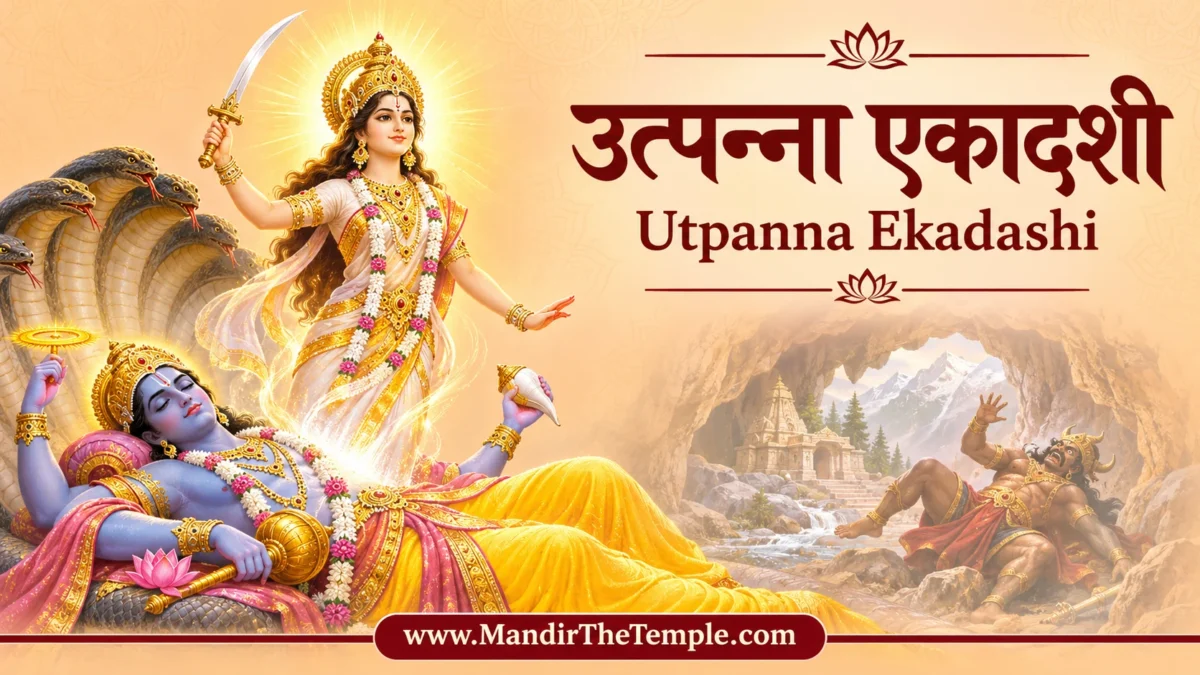
Utpanna Ekadashi (उत्पन्ना एकादशी) is the sacred day on which, according to tradition, a divine goddess emerged from the body of Lord Vishnu and destroyed the demon Mura. Vishnu named her “Ekadashi”. That is why this day is honoured as the appearance day of Ekadashi Devi, the “birthday” of Ekadashi itself.
Utpanna Ekadashi falls on the eleventh day of the waning moon (Krishna Paksha) in the month of Margashirsha (Agahan) in the North Indian Purnimanta calendar. In the Amanta calendar followed in Gujarat, Maharashtra and South India, the same day is called Kartik Krishna Ekadashi.
Because Ekadashi Devi first appeared on this day, many devotees choose Utpanna Ekadashi to begin their year-long Ekadashi fasting. In this guide you will find the 2026 date and Parana time, the complete Vrat Katha, step-by-step Puja Vidhi, mantras, food rules, and how to start the Ekadashi vrat for the first time.
Utpanna Ekadashi Date 2026: Tithi and Parana Time
Quick answer: In 2026, the Utpanna Ekadashi fast is on Friday, 4 December 2026. Ekadashi tithi runs from 11:03 PM on 3 December to 11:44 PM on 4 December, and Parana is on 5 December 2026 (roughly 6:59 AM to 9:04 AM in New Delhi).
Next Utpanna Ekadashi
Utpanna Ekadashi 2026
4 December 2026, Friday 33 days to go
- Month and paksha
- Margashirsha Krishna
- Ekadashi tithi
- 3 Dec 23:05 – 4 Dec 23:46
- Parana (breaking the fast)
- 5 Dec, 06:59 – 09:04
| Year | Fasting date | Ekadashi tithi | Parana |
|---|---|---|---|
| 2026 | 4 December 2026, Friday | 3 Dec 23:05 – 4 Dec 23:46 | 5 Dec, 06:59 – 09:04 |
| 2027 | 24 November 2027, Wednesday | 23 Nov 13:46 – 24 Nov 12:13 | 25 Nov, 06:51 – 08:57 |
| 2028 | 13 November 2028, Monday | 12 Nov 09:32 – 13 Nov 06:43 | 14 Nov, 06:43 – 08:52 |
| 2029 | 2 December 2029, Sunday | 1 Dec 12:41 – 2 Dec 09:53 | 3 Dec, 06:57 – 09:03 |
Dates follow the Smarta tradition by sunrise in the selected city (Delhi) and move forward automatically every year. Choose your city above for local timings. Times are approximate; check your local panchang.
The table above shows the date and Parana window for your city for this year and the coming years, and it updates automatically. Sunrise differs from city to city, so the Parana time can shift a little. For future years, always refer to the table above.
Smarta vs Vaishnava: When the Ekadashi tithi spans two days, householders (Smarta) fast on the first day and Vaishnava traditions such as ISKCON fast on the next. In 2026, both traditions observe Utpanna Ekadashi on the same day, 4 December.
Utpanna Ekadashi Meaning and Other Names
“Utpanna” means “one who was born” or “that which arose”. The name comes straight from the katha, in which a maiden was born from Lord Vishnu’s body. She was named Ekadashi, and the tithi on which she appeared became known as Utpanna Ekadashi.
Other names you may come across:
- Utpatti Ekadashi — common in Gujarat and in the Swaminarayan tradition.
- Utpattika Ekadashi — used in some texts and Vaishnava calendars.
- Margashirsha Krishna Ekadashi / Agahan Badi Ekadashi — the tithi name in North India.
- Kartik Krishna Ekadashi — in the Amanta calendar (Maharashtra, Gujarat, Karnataka, Andhra Pradesh and others).
| Calendar | Month and fortnight | Where it is followed |
|---|---|---|
| Purnimanta (North India) | Margashirsha Krishna Paksha Ekadashi | Uttar Pradesh, Uttarakhand, Bihar, Rajasthan, Madhya Pradesh, Delhi, Punjab, Haryana |
| Amanta (South and West India) | Kartik Krishna Paksha Ekadashi | Gujarat, Maharashtra, Karnataka, Andhra Pradesh, Telangana |
In the North Indian sequence, it is the first Ekadashi after Devuthani (Prabodhini) Ekadashi, and it is followed by Mokshada Ekadashi in Margashirsha Shukla Paksha, the day of Gita Jayanti.
Significance of Utpanna Ekadashi
Every month has two Ekadashis, each with its own glory, but Utpanna holds a special place. It is regarded as the root of them all. The power after whom all 24 Ekadashis of the year (26 in a year with Adhik Maas) are named appeared on this very day.
Religious Significance
According to tradition, worshipping Lord Vishnu together with Ekadashi Devi on this day removes sins and purifies the mind. In the katha, Vishnu himself blesses Ekadashi Devi that whoever fasts on her day with devotion will receive his grace. Vaishnava devotees therefore observe this day with great reverence.
The katha also says the merit of this fast equals that of many pilgrimages and charities; some versions compare it to bathing at Shankhoddhara Tirtha and having darshan of the Lord.
Spiritual Message
The deeper message of the story is this: when we “fall asleep”, when our awareness drops, our inner faults (the demon Mura) attack. At such moments the inner power given by God, which is self-restraint, fasting and devotion, protects us. Ekadashi Devi is the symbol of that power of restraint.
“Ekadasha” means eleven. Tradition links it to mastering the five senses of perception, the five organs of action and the mind. So the fast is practice in governing the senses, not just skipping food.
Mention in the Puranas
According to tradition, the story of Utpanna Ekadashi comes from the Bhavishyottara Purana (the later section of the Bhavishya Purana), where Lord Krishna explains the origin and glory of Ekadashi to Arjuna. Some katha collections present the same conversation between Krishna and Yudhishthira. Ekadashi mahatmya stories are also recited in traditions linked to the Padma Purana.
Utpanna Ekadashi Vrat Katha
Arjuna once asked Lord Krishna, “O Janardana, why is the Ekadashi fast so glorious? How did this tithi come into being, and how should the fast be observed?” Krishna then narrated the story of the Ekadashi of Margashirsha Krishna Paksha.
In Satya Yuga there lived a mighty and fearsome demon named Mura. He was the son of the demon Nadijangha and ruled from the city of Chandravati. Proud of his strength, Mura attacked the devas, defeated Indra and all the gods, and drove them out of heaven. He placed his own demons in the seats of Indra, Agni, Varuna, Yama, Vayu and Chandra.
Indra led the distressed gods to Lord Shiva and told him their sorrow. Shiva said, “O king of the gods, take refuge in Lord Vishnu, the master of the three worlds. Only he can end your suffering.”
The gods went to the Ocean of Milk (Kshira Sagara), where Vishnu lay in yogic sleep on the serpent Shesha. With folded hands they praised him: “O Lord, a demon named Mura has thrown us out of heaven. We have come to you for shelter. Please protect us.”
Hearing about Mura and his city, Vishnu reassured the gods and set out with them for Chandravati.
As soon as they arrived, Mura’s huge army attacked. The demons were so many that the gods fled in fear. Vishnu then took up the fight himself. His arrows, Sudarshana Chakra and mace destroyed countless demons, but Mura stood firm. No weapon seemed to defeat him.
After weapons, the two fought hand to hand. According to the story, this battle went on for thousands of years; most versions say ten thousand, while some say one thousand. Even then Mura was not defeated.
Weary from the fight, Vishnu went to Badrikashram to rest. There was a beautiful cave there called Hemavati, with only one entrance. Vishnu entered it and lay down in yogic sleep.
Mura followed him to the cave. Seeing the Lord asleep, he thought this was his chance and moved in to kill him. At that very moment, a radiant and beautiful maiden emerged from Vishnu’s body, armed with divine weapons.
She challenged Mura to battle. A fierce fight followed. The goddess destroyed his weapons and chariot and finally beheaded him. When Mura fell, the remaining demons fled in terror to Patala.
When Vishnu awoke, he saw Mura lying dead and a shining maiden standing before him with folded hands. Astonished, he asked, “Who killed this mighty demon?” She replied humbly, “O Lord, I was born from your own body. This wicked one wanted to kill you in your sleep, so I destroyed him.”
Vishnu was delighted. “O auspicious one, you have done a great service to the gods and the three worlds. Ask for any boon.” The goddess said, “O Lord, if you are pleased, grant that whoever fasts on my day is freed from sin and attains your grace and Vaikuntha. And let even those who eat only once on that day receive merit and prosperity.”
Vishnu said, “So be it. You were born on the eleventh tithi, so your name will be Ekadashi. My devotees will be your devotees too. Among all tithis you will be dearest to me, and the merit of your fast will surpass all pilgrimages.” Saying this, he vanished.
Krishna told Arjuna, “O Partha, from that day the Ekadashi fast spread in the world. According to tradition, whoever keeps this fast with faith and hears or recites this story is freed from sin and becomes dear to Lord Vishnu.”
Jai Ekadashi Mata! Jai Shri Hari Vishnu!
The Appearance of Devi Ekadashi and the Meaning of the Mura Story
Saints and katha speakers draw several lessons from this story:
- Mura — often seen as the faults that keep returning, such as greed, anger, laziness and ego. They do not give up easily, even after a long “war”.
- Vishnu’s rest — when a seeker is tired or careless, these faults strike hardest.
- Devi Ekadashi — the power that rises from within the Lord: fasting, restraint and devotion. This is what protects the seeker in hard times.
- The single door of the Hemavati cave — some speakers relate it to a focused mind, which has only one way in: remembrance of God.
A goddess, feminine shakti, achieved what ages of battle could not, which is why she is worshipped as “Ekadashi Mata” and many homes sing the Ekadashi Mata Ki Aarti on this day.
Why Start the Ekadashi Vrat from Utpanna Ekadashi
An old and widespread custom in North India says that anyone who wants to begin regular Ekadashi fasting should start on Utpanna Ekadashi. The reasons are simple:
- It is Ekadashi’s appearance day — beginning her fast on the day she appeared is naturally seen as auspicious.
- The katha marks the beginning — at the end of the story, the Lord says that the Ekadashi fast spread in the world from this day.
- The season helps — cooler weather means less thirst for first-timers.
- The sanctity of Margashirsha — in the Gita, Krishna says “masanam margashirsho’ham”, “among months I am Margashirsha”. A new vow in this month is considered auspicious.
How to Start the Ekadashi Fast for the First Time
- Ask family elders, your family priest or guru which rule your tradition follows: nirjala, phalahar or one meal.
- Eat sattvic food from Dashami evening and decide how many Ekadashis you will observe, for example all 24 in a year, or only the Shukla Paksha ones.
- On the morning of Utpanna Ekadashi, take a sankalp before Lord Vishnu with water, akshat and flowers in your hand.
- In the first year, keep a lighter fast (phalahar) and let your body adjust gradually.
- On every Ekadashi, read or hear that Ekadashi’s katha, and break the fast at the correct Parana time on Dwadashi.
- When the vow is complete (for example after a year), an udyapan is traditionally performed with puja, havan, feeding Brahmins and charity. Many families also do the udyapan on Utpanna or Mokshada Ekadashi.
Which Is the First Ekadashi?
This question has two answers. By origin, Utpanna Ekadashi is considered the first Ekadashi, because Ekadashi Devi appeared on this day. Counting from the Hindu New Year (Chaitra Shukla Pratipada), the first Ekadashi of the year is Kamada Ekadashi in Chaitra Shukla. The custom of starting the vrat follows the first meaning.
Utpanna Ekadashi Puja Vidhi (Step by Step)
- Dashami preparation: On the day before Ekadashi, eat a light sattvic meal before sunset. Avoid onion, garlic, meat, alcohol and tamasic food. Sleep remembering the Lord, with the intention of the fast in your heart.
- Wake in Brahma Muhurta: Rise before sunrise on Ekadashi and bathe, adding a little Gangajal to the water if possible. Wear clean clothes, preferably yellow or white.
- Prepare the altar: Clean the home shrine. Spread a yellow cloth on a small platform and place an idol or picture of Lord Vishnu, Krishna or a Shaligram. Sprinkle Gangajal to purify the space.
- Sankalp: Hold water, akshat, a flower and a coin in your right hand, say your name, gotra and place, and pray: “Today I observe the Utpanna Ekadashi fast with devotion for the pleasure of Lord Vishnu and Ekadashi Mata. O Lord, let it be completed without obstacles.” Then release the water on the ground.
- Lamp and invocation: Light a ghee lamp. Meditate on the Lord and invite him into the puja. Remember Ekadashi Mata as well.
- Panchopachar or Shodashopachar puja: Bathe the idol with water or panchamrit, then offer clothes, sandalwood, roli, akshat, yellow flowers and tulsi leaves. Offer incense and lamp. Pluck tulsi leaves a day earlier, because plucking tulsi on Ekadashi is traditionally avoided.
- Bhog: Offer fruits, grain-free sweets, panchamrit or makhana kheer. Place a tulsi leaf on every offering; tradition holds that Vishnu’s bhog is incomplete without tulsi.
- Mantra jaap: Chant “Om Namo Bhagavate Vasudevaya” at least 108 times. Reciting the Vishnu Sahasranama or a few chapters of the Bhagavad Gita is also excellent.
- Katha: Read the Utpanna Ekadashi Vrat Katha yourself or listen to it with family. Tradition considers the fast incomplete without it.
- Aarti: After the katha, sing Om Jai Jagdish Hare and the Ekadashi Mata Ki Aarti.
- Evening puja: Light a lamp again in the evening, offer a lamp near the tulsi plant and perform aarti.
- Night jagran (if possible): Sing bhajans or read the Lord’s stories at night. If a full night is not possible, rest after late bhajan.
- Dwadashi Parana: Next morning, bathe and worship, give food or charity to a Brahmin or someone in need, and break the fast within the Parana window shown in the table above. Begin with water containing a tulsi leaf or charanamrit.
Puja Samagri List
- Idol, picture or Shaligram of Lord Vishnu or Krishna
- Small platform (chowki) and a yellow cloth
- Gangajal and a kalash of clean water
- Panchamrit (milk, curd, ghee, honey, sugar)
- Tulsi leaves (plucked the day before)
- Yellow flowers and a garland
- Sandalwood, roli, turmeric and akshat (whole rice for puja only, not for eating)
- Ghee lamp, cotton wicks, matches
- Incense sticks and camphor
- Seasonal fruits, bananas, coconut
- Makhana, dry fruits or grain-free sweets for bhog
- Betel leaves, betel nut, cloves, cardamom
- Yellow cloth or sacred thread to offer the Lord
- Dakshina and items for charity (grain, blankets, warm clothes)
- Vrat katha book and an aarti collection
You can also download our Aarti Sangrah PDF to keep all the aartis in one place.
Utpanna Ekadashi Mantras
Chant these with a tulsi or sandalwood mala and a calm mind. Clear pronunciation matters more than the count.
1. Vasudeva Dvadashakshara Mantra
ॐ नमो भगवते वासुदेवाय (Om Namo Bhagavate Vasudevaya)
Meaning: I bow to Lord Vasudeva (Krishna/Vishnu). This is the most widely chanted mantra on Ekadashi.
2. Narayana Ashtakshara Mantra
ॐ नमो नारायणाय (Om Namo Narayanaya)
Meaning: I bow to Lord Narayana. Short and simple, it can be chanted through the day.
3. Vishnu Gayatri Mantra
Om Narayanaya Vidmahe Vasudevaya Dhimahi, Tanno Vishnuh Prachodayat
Meaning: May we know Narayana and meditate on Vasudeva; may Lord Vishnu guide our understanding.
4. Vishnu Dhyana Mantra
Shantakaram Bhujagashayanam Padmanabham Suresham, Vishvadharam Gaganasadrisham Meghavarnam Shubhangam. Lakshmikantam Kamalanayanam Yogibhirdhyanagamyam, Vande Vishnum Bhavabhayaharam Sarvalokaikanatham.
Meaning: I bow to Lord Vishnu, the peaceful one who reclines on the serpent, from whose navel the lotus springs, lord of the gods, support of the universe, vast as the sky and dark as a rain cloud; husband of Lakshmi, lotus-eyed, reached by yogis in meditation, remover of the fear of worldly existence and sole lord of all worlds. It suits this day well, since the katha shows Vishnu on Shesha and in yogic sleep.
5. Krishna Pranam Mantra
Krishnaya Vasudevaya Haraye Paramatmane, Pranata Klesha Nashaya Govindaya Namo Namah
Meaning: Salutations again and again to Krishna, Vasudeva, Hari, the Supreme Soul, Govinda, who removes the distress of those who surrender. As Krishna narrated this katha, it is lovely to recite after the story.
What to Eat and Avoid During the Utpanna Ekadashi Fast
The best-known Ekadashi rule is no grains, especially rice. Beyond that, choose the type of fast that suits your health and tradition.
| You can eat (phalahar) | Avoid |
|---|---|
| All seasonal fruits, banana, apple, papaya, pomegranate | Rice and rice products |
| Milk, curd, buttermilk, paneer, butter | Wheat, barley, maize, millet and their flours |
| Sabudana, makhana, water chestnut flour, buckwheat (kuttu), amaranth (rajgira) | Lentils, chickpeas, kidney beans, soybean |
| Potato, sweet potato, arbi, raw banana, bottle gourd, pumpkin | Onion and garlic |
| Peanuts, dry fruits, coconut | Meat, fish, eggs, alcohol, tobacco |
| Rock salt (sendha namak), black pepper, cumin, green chilli | Regular iodised salt and some spices such as turmeric and hing (as per tradition) |
Phalahar rules vary a little between families and traditions such as ISKCON; follow your own household custom.
Nirjala Fast
In a nirjala fast, no food or water is taken from sunrise until Parana the next day. It is the hardest form. Only those in good health who are used to fasting should attempt it, and first-timers should not begin with nirjala.
Phalahar Fast
This is the most common way. Grains are given up and fruits, milk and the fasting foods above are taken, with water allowed freely. Most householders fast this way, and it is the best choice for beginners.
One-Meal (Ekabhukta) Fast
Here a single phalahari meal is eaten during the day, with only water or milk otherwise. In the Utpanna katha, Ekadashi Devi herself asks that those who eat only once on her day also receive merit, so this option is fully in line with tradition.
Important health note: People with diabetes, blood pressure, heart or kidney conditions, pregnant or breastfeeding women, the elderly, children and anyone on regular medication should consult their doctor before a nirjala or long fast. They can observe the vrat with devotion through phalahar or by simply avoiding grains. Do not stop prescribed medicines.
Utpanna Ekadashi Parana: When and How to Break the Fast
The fast is believed to be complete only when it is broken correctly and on time:
- Break the fast on Dwadashi: Parana should be done the next day, after sunrise and before Dwadashi tithi ends. Breaking it after Dwadashi has passed is considered a fault.
- Not during Harivasara: The first quarter of Dwadashi tithi is called Harivasara. The fast is not broken during this period; wait until it ends.
- Morning is best: Morning is the preferred time. Breaking the fast at midday is generally avoided; if the morning is not possible, do it after midday.
- Smarta and Vaishnava: In years when the two traditions fast on different days, the Parana day and time also differ. Follow your own tradition.
- City-specific timing: Parana depends on sunrise, so check your city in the table above. Our Daily Panchang is also useful.
Simple Parana Method
- On Dwadashi morning, bathe, worship Lord Vishnu and light a lamp.
- Offer bhog and thank the Lord for completing the fast. Ask forgiveness for any unknowing mistakes.
- Give food, grain or warm clothes to a Brahmin or someone in need.
- First take water with a tulsi leaf, or charanamrit.
- Then eat a sattvic meal. Many families break the fast with rice, to mark that the grain vow is complete.
- Avoid onion, garlic and tamasic food in the Parana meal too.
Do’s and Don’ts on Utpanna Ekadashi
Do’s
- Remember and worship Ekadashi Mata along with Lord Vishnu.
- Read or listen to the Utpanna Ekadashi Vrat Katha.
- Chant “Om Namo Bhagavate Vasudevaya” and recite the Vishnu Sahasranama or the Gita.
- Light a ghee lamp near the tulsi plant in the evening.
- It is winter, so donate blankets, warm clothes, grain or fruit to those in need.
- Keep the mind calm and speak kindly and truthfully.
- If you want to begin Ekadashi fasting, take the vow today.
- Note the correct Parana time for Dwadashi.
Don’ts
- Do not eat rice or any grain.
- Do not pluck tulsi leaves on Ekadashi.
- Stay away from onion, garlic, meat, alcohol and intoxicants.
- Avoid quarrels, anger, lies and gossip.
- Avoid cutting hair or nails and shaving (as per tradition).
- Many families avoid eating food cooked by others on this day.
- Do not break the fast during Harivasara or after Dwadashi ends.
- Do not force a strict fast if you are unwell.
Utpanna Ekadashi Myths and Reality
Myth: Only a nirjala fast brings the merit of Utpanna Ekadashi.
Reality: Tradition accepts nirjala, phalahar and one-meal fasts. In the Utpanna katha itself, Ekadashi Devi asks for merit even for those who eat once. The scriptures stress devotion, restraint and remembrance of God, not punishing the body.
Myth: The Ekadashi vrat can only be started on Utpanna Ekadashi.
Reality: Starting on Utpanna is a very popular and auspicious custom because it is Ekadashi’s appearance day. But it is not a strict requirement. Many families and sampradayas begin on another Ekadashi on the advice of their guru or priest.
Myth: Eating rice on Ekadashi means rebirth as an insect.
Reality: This is a folk saying meant to stress the grain-free rule. Tradition does prohibit grains, especially rice, on Ekadashi, and devotees follow it with faith. But it is better seen as discipline and love for the Lord rather than fear. If you eat grain by mistake, ask forgiveness and continue the vow.
Myth: If the fast breaks, a whole year’s merit is lost.
Reality: If illness, medicine or some compulsion breaks the fast, there is no need to panic. Tradition suggests praying to Lord Vishnu for forgiveness, chanting “Om Namo Bhagavate Vasudevaya” and giving charity as you can. Then continue with faith from the next Ekadashi.
Myth: Only Lord Vishnu is worshipped on Utpanna Ekadashi, not Ekadashi Mata.
Reality: In the katha, Ekadashi Devi is Vishnu’s own shakti, born from his body. So both are honoured on this day. Worshipping Vishnu and also remembering Ekadashi Mata and singing her aarti is fully in keeping with tradition.
Myth: You can break the fast any time on Dwadashi.
Reality: Tradition gives clear Parana rules: within Dwadashi tithi, after sunrise, and after Harivasara ends. That is why panchangs publish a specific Parana window every year. Check your city in the table above.
Myth: Everyone must fast equally strictly, whatever their health.
Reality: The dharma texts allow relaxations for the sick, elderly, children and pregnant women. People with diabetes, blood pressure or on regular medication should not keep a nirjala fast without medical advice. They can still observe the vrat sincerely through phalahar, avoiding grains, japa and listening to the katha.
Benefits of Utpanna Ekadashi (Religious Belief)
These benefits are matters of faith and tradition, not guarantees.
- Removal of sins: In the katha, Vishnu blesses that those who fast with devotion on this day are freed from sin.
- Lord Vishnu’s grace: It is believed that devotees of Ekadashi Mata are dear to the Lord.
- Merit like pilgrimage and charity: Tradition compares the merit of this fast to many holy baths and yajnas.
- Peace of mind and self-control: A day without grain, with japa and katha, is seen as a help in calming the mind and governing the senses.
- Prosperity: According to the katha, even those who keep the fast with one meal receive blessings of abundance.
- A step towards moksha: In Vaishnava tradition, regular Ekadashi fasting is a means of devotion and liberation.
- A fresh spiritual start: As the day for beginning the Ekadashi vrat, it is a good opportunity to start a regular spiritual practice.
Related Ekadashis and Prayers
Just before Utpanna comes Devuthani (Prabodhini) Ekadashi in Kartik Shukla Paksha, when Lord Vishnu wakes from his yogic sleep. The month of Kartik then ends with Kartik Purnima, and Margashirsha begins.
After Utpanna comes Mokshada Ekadashi in Margashirsha Shukla Paksha, which is also celebrated as Gita Jayanti. See all Ekadashis of the year with dates on our Ekadashi Kab Hai page.
For the puja, also read the Ekadashi Mata Ki Aarti, Om Jai Jagdish Hare Aarti and Tulsi Mata Ki Aarti.
Utpanna Ekadashi reminds us that the strength God gives is already within us. Whenever “Mura”-like difficulties come into life, restraint, faith and remembrance of the Lord’s name protect us. If you have long wanted to begin the Ekadashi fast, there is hardly a better day than the appearance day of Ekadashi Mata. May Ekadashi Mata and Shri Hari bless you and your family.
Om Namo Bhagavate Vasudevaya. Jai Ekadashi Mata!
Frequently asked questions
When is Utpanna Ekadashi in 2026?
In 2026, the Utpanna Ekadashi fast is on Friday, 4 December 2026, with Parana on the morning of 5 December. See the date table on this page for your city’s Parana time and for future years.
In which month does Utpanna Ekadashi fall?
It is the Krishna Paksha Ekadashi of Margashirsha (Agahan) in the North Indian Purnimanta calendar. In the Amanta calendar used in Gujarat, Maharashtra and South India, the same day is Kartik Krishna Ekadashi.
Why is it called Utpanna Ekadashi?
According to the katha, Ekadashi Devi emerged from Lord Vishnu’s body on this tithi and killed the demon Mura. ‘Utpanna’ means ‘one who was born’, hence the name.
What is the Utpanna Ekadashi Vrat Katha?
In Satya Yuga the demon Mura drove the gods from heaven. Vishnu fought him for ages and then rested in the Hemavati cave at Badrikashram, where a goddess born from his body killed Mura; Vishnu named her Ekadashi.
Who was the demon Mura?
Mura was the son of the demon Nadijangha and lived in the city of Chandravati. He had defeated Indra and all the gods.
Should the Ekadashi fast be started on Utpanna Ekadashi?
Yes, this is a widely followed custom because it is Ekadashi Devi’s appearance day. It is not compulsory, though; follow the advice of your family tradition or guru.
Which is the first Ekadashi?
By origin, Utpanna Ekadashi is considered the first Ekadashi. Counting from the Hindu New Year (Chaitra Shukla Pratipada), the first Ekadashi of the year is Kamada Ekadashi.
Which deity is worshipped on Utpanna Ekadashi?
Lord Vishnu (or Krishna) is worshipped, along with remembrance and aarti of Ekadashi Mata.
What can we eat during the Utpanna Ekadashi fast?
Fruits, milk, curd, sabudana, makhana, buckwheat or water chestnut flour, potato, sweet potato and food cooked with rock salt are allowed. Follow your family custom as well.
Can we drink water on Ekadashi?
Yes, water is allowed in the phalahar and one-meal fasts. Only in a nirjala fast is water avoided until Parana.
Can we eat rice on Ekadashi?
No. By tradition, rice and all grains are avoided on Ekadashi, even by many people who are not fasting.
When and how should the Utpanna Ekadashi Parana be done?
Break the fast on Dwadashi, after sunrise and after Harivasara ends, before Dwadashi tithi is over. Begin with tulsi water or charanamrit, then a sattvic meal; city-wise timings are in the table on this page.
What is Harivasara?
Harivasara is the first quarter of Dwadashi tithi. The Ekadashi fast is not broken during this period.
What is the difference between Smarta and Vaishnava Ekadashi?
When the Ekadashi tithi spans two days, householders (Smarta) fast on the first day and Vaishnavas such as ISKCON fast on the next. In 2026, both observe Utpanna Ekadashi on the same day.
Which mantra should be chanted on Utpanna Ekadashi?
The most popular mantra is ‘Om Namo Bhagavate Vasudevaya’, chanted 108 times. ‘Om Namo Narayanaya’ and the Vishnu Gayatri are also chanted.
Can pregnant women and the elderly keep this fast?
Yes, but they should avoid a nirjala fast and consult a doctor first. A phalahar fast, avoiding grains, japa and hearing the katha are sincere ways to observe it.
What should I do if my Ekadashi fast breaks?
Do not worry; ask Lord Vishnu for forgiveness, chant his mantra and give charity as you can. Continue with faith from the next Ekadashi.
Which Ekadashi comes after Utpanna Ekadashi?
Mokshada Ekadashi of Margashirsha Shukla Paksha comes next, and Gita Jayanti is celebrated on the same day.