
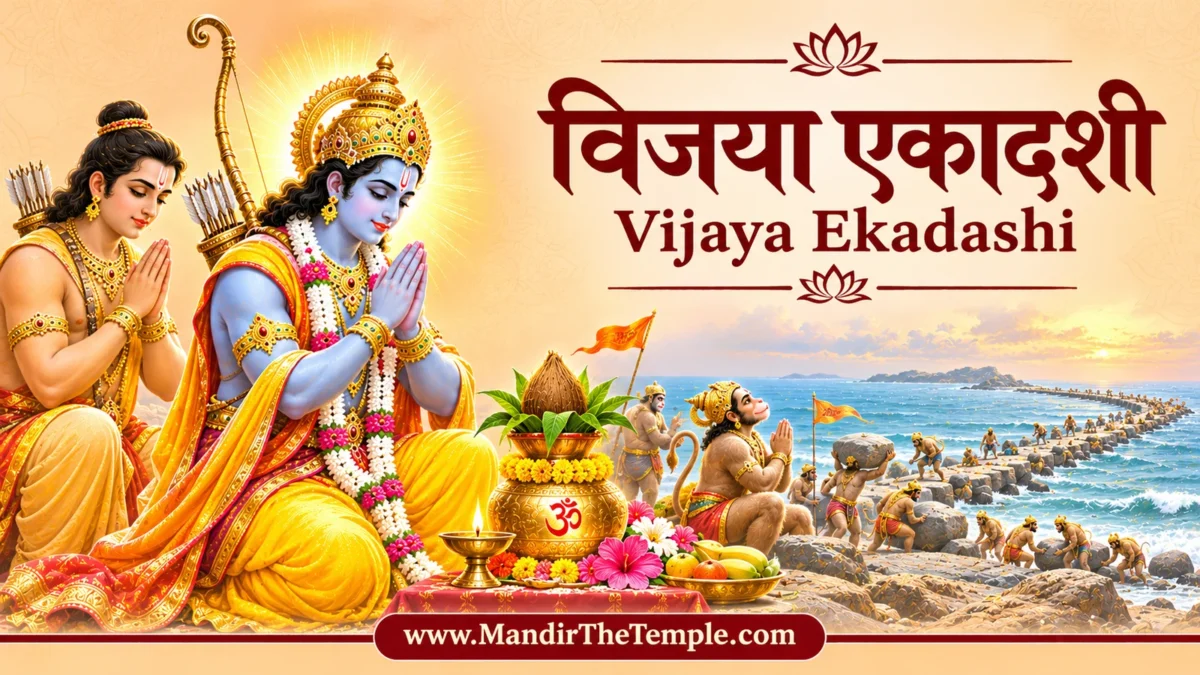
Vijaya Ekadashi (विजया एकादशी) is the Ekadashi of the waning fortnight (Krishna Paksha) of the month of Phalguna, and it is traditionally kept as the fast that grants victory and success. The name says it all: “Vijaya” means “the one who gives victory”. On this day devotees worship Lord Vishnu in his Narayana form and fast with a prayer to overcome the obstacles in their lives.
The best-known story of this Ekadashi belongs to Lord Rama. According to tradition, before the march on Lanka, while the vanara army was stranded on the seashore, Rama kept this very fast with his commanders on the advice of the sage Vakadalbhya (also spelt Bakadalbhya). The ocean was then crossed and Ravana was defeated. That is why it is often called “the fast Rama kept before the victory of Lanka”.
Vijaya Ekadashi also has a ritual of its own: the Saptadhanya Kalash Sthapana. The vrat katha itself describes installing a water pot on seven grains and placing an image of Lord Narayana on top of it.
Vijaya Ekadashi Date 2027: Tithi and Parana Time
Quick answer: Vijaya Ekadashi 2026 (13 February) has already passed. The next Vijaya Ekadashi falls on Thursday, 4 March 2027. As per the New Delhi panchang, Ekadashi tithi begins at 4:44 AM on 3 March and ends at 7:24 AM on 4 March, and parana can be done on 5 March between 6:42 AM and 9:03 AM.
Next Vijaya Ekadashi
Vijaya Ekadashi 2027
3 March 2027, Wednesday 122 days to go
- Month and paksha
- Phalguna Krishna
- Ekadashi tithi
- 3 Mar 04:46 – 4 Mar 07:26
- Parana (breaking the fast)
- 4 Mar, 14:03 – 16:02
- Vaishnava / ISKCON fast
- 4 March 2027, Thursday · Parana: 5 Mar, 06:42 – 09:02
| Year | Fasting date | Ekadashi tithi | Parana |
|---|---|---|---|
| 2026 | 13 February 2026, Friday | 12 Feb 12:24 – 13 Feb 14:28 | 14 Feb, 07:00 – 09:14 |
| 2027 | 3 March 2027, Wednesday Vaishnava: 4 Mar | 3 Mar 04:46 – 4 Mar 07:26 | 4 Mar, 14:03 – 16:02 |
| 2028 | 20 February 2028, Sunday Vaishnava: 21 Feb | 20 Feb 03:50 – 21 Feb 05:48 | 21 Feb, 13:43 – 15:59 |
| 2029 | 9 February 2029, Friday | 8 Feb 12:46 – 9 Feb 12:35 | 10 Feb, 07:03 – 09:16 |
Dates follow the Smarta tradition by sunrise in the selected city (Delhi) and move forward automatically every year. Choose your city above for local timings. Times are approximate; check your local panchang.
The table above automatically shows the date and parana time for your city for this year and the coming years. Sunrise differs from city to city, so always take the parana time for your own location.
Smarta and Vaishnava: When Ekadashi tithi touches two sunrises, householders (Smarta) and Vaishnava traditions such as ISKCON sometimes fast on different days. In 2027 the tithi is present at sunrise on both days, so you may see small differences between panchangs. Drik Panchang and several others list 4 March for both traditions in New Delhi, while some panchangs (and the calculation in our table) show 3 March for householders and 4 March for Vaishnavas. In such cases, follow your family tradition, local temple or priest.
Vijaya Ekadashi Meaning and Other Names
“Vijaya” comes from “vijay”, meaning victory, success or getting past a difficulty. So Vijaya Ekadashi means “the Ekadashi that grants victory”. In the katha, Lord Brahma himself says that whoever keeps this vrat attains victory, and the episode of Rama’s conquest of Lanka made the name famous.
Other names of Vijaya Ekadashi
- Phalguna Krishna Ekadashi — the name by tithi in North India (Purnimanta calendar).
- Magha Krishna Ekadashi — the name for the same day in South and West India (Amanta calendar).
- Vijay Ekadashi — a common colloquial form.
- Vijaya Ekadasi — the spelling used in ISKCON and Vaishnava calendars.
Month in the Purnimanta and Amanta calendars
North India follows the Purnimanta calendar, where a month ends on Purnima (full moon). South and West India (Maharashtra, Gujarat, Karnataka, Andhra Pradesh and others) follow the Amanta calendar, where a month ends on Amavasya (new moon). Because of this, the name of the month for a Krishna Paksha shifts by one between the two systems.
So Vijaya Ekadashi is Phalguna Krishna Ekadashi in North India and Magha Krishna Ekadashi in the Amanta calendar. It is the same day; only the month name differs. It usually falls in February or March.
In sequence, it comes after Jaya Ekadashi (Magha Shukla) and before Amalaki Ekadashi (Phalguna Shukla). Maha Shivratri arrives just a few days after Vijaya Ekadashi, which makes this a deeply devotional time of the year.
Significance of Vijaya Ekadashi
Vijaya Ekadashi is linked with victory, courage and success in difficult undertakings, so many people keep it before starting something new or in the middle of a hard struggle.
Religious significance
By tradition, the Vijaya Ekadashi fast is said to destroy sins both old and new. In the katha, Brahma calls it the best among vratas. Devotees believe that one who keeps it with faith gains victory in this world and the next.
Lord Rama is remembered along with Lord Vishnu, and many families read the Sundar Kand of the Ramcharitmanas on this day.
Spiritual message
The deeper message of Vijaya Ekadashi is that before winning a battle outside, one must win the battle within. Rama was himself an avatar of Vishnu, yet he accepted a sage’s counsel, fasted humbly and moved forward only after full preparation. True success comes not from ego but from restraint, patience, right guidance and trust in God.
Rama also fasts together with his commanders, a reminder that a great goal needs a team united in mind.
Mention in the Puranas
According to tradition, the glory of Vijaya Ekadashi is described in the Skanda Purana, and it also appears in the Ekadashi-mahatmya sections associated with the Padma Purana. There, Yudhishthira asks Lord Krishna about the Phalguna Krishna Ekadashi, and Krishna recounts the story that Brahma once told the sage Narada.
The katha closes by saying that reading or hearing its glory brings merit equal to the Vajapeya yajna. Such statements are made in the language of faith and devotion and are best understood in that spirit.
Vijaya Ekadashi Vrat Katha: Lord Rama’s Fast Before Lanka
Once, Yudhishthira humbly asked Lord Krishna, “O Janardana, I have heard the glory of Jaya Ekadashi of Magha Shukla. Now please tell me the name of the Ekadashi of the dark fortnight of Phalguna, and how it should be observed.”
Krishna replied, “O King, this Ekadashi is called Vijaya, and it gives victory to the one who keeps it. Long ago the sage Narada asked Lord Brahma about it. Brahma said: Narada, this vrat destroys all sins, old and new. I have never revealed its method to anyone before. Listen now to its story.”
Sita’s abduction and Rama at the shore
Brahma said: In the Treta Yuga, Shri Rama, an avatar of Vishnu, was living in exile at Panchavati with Lakshmana and Mother Sita. There Ravana, king of Lanka, abducted Sita by deceit. Grief-stricken, Rama and Lakshmana searched the forests for her.
On the way they met the wounded Jatayu, who told them what had happened and then gave up his life. Rama then formed a friendship with the vanara king Sugriva and slew Bali. Hanuman leapt to Lanka, found Sita in the Ashoka grove and brought the news back to Rama.
Rama then marched with Sugriva’s vast army and reached the ocean. Before them lay an endless sea teeming with crocodiles and fearsome creatures. Rama said to Lakshmana, “This ocean is deep and vast. I see no way to cross it. How shall we reach the other side?”
The counsel of sage Vakadalbhya
Lakshmana said, “My Lord, you are the Primeval Being and know everything. Still, half a yojana from here, on Kumari Dvipa (an island), lives the sage Vakadalbhya. He is a great ascetic who is said to have seen many Brahmas. Let us go and ask him.”
Rama went with Lakshmana to the hermitage and bowed to the sage. The sage recognised that the Lord himself stood before him in human form. “O Rama, what brings you here?” he asked. Rama replied, “Revered sage, I have come with my army to win Lanka. Please tell me how this ocean can be crossed.”
The sage said, “O Rama, keep the fast of Vijaya Ekadashi, which falls in the dark fortnight of Phalguna. If you and your commanders observe it properly, you will cross the ocean and win Lanka.”
The kalash puja described by the sage
The sage then explained the method: “On Dashami, prepare a pot (kalash) of gold, silver, copper or clay. Fill it with water, place five leaves (pancha pallava) in its mouth and set it on an altar. Put seven kinds of grain (satnaja) beneath it and barley on top. On it install a golden image of Lord Narayana.”
“On Ekadashi, after bathing, worship Lord Narayana with incense, lamp, food offerings and coconut. Spend the whole day devotedly before the kalash and keep vigil through the night in the same way. On Dwadashi, after your daily rites, bathe at the bank of a river or pond, worship the kalash and give it to a worthy brahmin.”
Rama’s fast and the victory of Lanka
Following the sage’s instruction, Rama observed Vijaya Ekadashi with his commanders when Phalguna Krishna Ekadashi came. He installed the kalash, worshipped Narayana through the day, kept vigil at night, and on Dwadashi gave away the kalash and broke the fast.
By the power of this vrat, Rama’s army crossed the ocean and reached Lanka. Ravana and the rakshasas were defeated, victory came to Rama and Sita was freed. Brahma told Narada, “Whoever keeps this vrat in this way wins victory in this world, and the next world is blessed too.”
At the end, Krishna told Yudhishthira, “O King, whoever reads or hears this glory gains merit equal to the Vajapeya sacrifice.”
Lesson of the story: Even as the Lord, Rama sought a sage’s guidance and kept the fast with discipline. Before any great task we need humility, sound advice, preparation and remembrance of God. It is customary to sing the Ekadashi Mata Ki Aarti after reading the katha.
Saptadhanya Kalash Sthapana Vidhi
What sets the Vijaya Ekadashi puja apart is the Saptadhanya Kalash described in the katha. A gold pot and gold image are not possible for most families today, so most homes use a copper, brass or clay kalash with an image or picture of Lord Vishnu. The devotion is what counts.
What is Saptadhanya?
Saptadhanya means seven kinds of grain; the katha calls it “satnaja”. The exact list varies by region. Commonly used grains are:
- Barley (jau)
- Wheat
- Rice or paddy
- Sesame (til)
- Foxtail millet (kangni)
- Green gram (moong)
- Chickpea (in some traditions urad or masoor instead)
Ready “satnaja” packs are sold in most markets. These grains are for worship only and are later donated or fed to birds.
How to install the kalash
- Clean the puja area, set up a chowki or small altar and cover it with a yellow or red cloth.
- Make a small heap of saptadhanya on the altar.
- Fill a copper, brass or clay kalash with clean water and add a little Ganga jal, a betel nut, a coin and akshat (rice grains for worship).
- Place five mango leaves in the mouth of the kalash and set it on the grain heap.
- Cover the mouth with a lid or shallow bowl filled with barley. Some traditions also place a pomegranate or coconut here.
- Place a small image of Lord Vishnu/Narayana on the barley, or keep his picture beside the kalash.
- Draw a swastika with roli, tie mauli (sacred thread) around the neck and offer a garland.
- Do your puja, japa and katha in front of this kalash through the day, and keep a lamp burning here during the night vigil.
- On Dwadashi, after bathing, worship the kalash and donate it with the grains to a brahmin, priest or temple. Pour the water at the root of a tulsi or any plant.
The kalash may be installed on Dashami evening (as in the katha) or on Ekadashi morning after the sankalp; follow your family custom.
Vijaya Ekadashi Puja Vidhi (Step by Step)
The method below is for householders. If your family or sampradaya has its own custom, follow that first. Faith and sincerity matter most; do not worry if some items are missing.
Dashami (the day before)
- Eat one simple sattvik meal before sunset. Avoid rice, masoor dal, onion, garlic and non-vegetarian food.
- Observe celibacy at night and keep the next day’s vow in mind.
- Clean the puja space and keep the saptadhanya, kalash, mango leaves, barley and tulsi ready. Pick tulsi leaves on Dashami itself.
- If you wish, install the Saptadhanya Kalash on Dashami evening.
Ekadashi morning and sankalp
- Wake before sunrise, bathe and wear clean (preferably yellow) clothes.
- Offer water to the Sun.
- Holding water, akshat and a flower, take the sankalp: “Today I keep the Vijaya Ekadashi fast to please Lord Vishnu and with a prayer for victory over the obstacles in my life.” Say your name and gotra, and silently state your wish.
- Decide the type of fast (nirjala, phalahar or one meal) according to your health.
Worship of Lord Vishnu and Lord Rama
- Begin by remembering Lord Ganesha.
- Install the Saptadhanya Kalash now if you have not already.
- Bathe the image of Lord Vishnu with Ganga jal, then with panchamrit (milk, curd, ghee, honey, sugar), and again with clean water.
- Offer yellow cloth, yellow sandalwood, yellow flowers, akshat and tulsi. Keep a picture of Lord Rama alongside and offer him flowers too.
- Light incense and a lamp and offer fruit, coconut, sweets or panchamrit, always with a tulsi leaf.
- Chant “Om Namo Bhagavate Vasudevaya” at least one mala (108 times). You can also chant “Shri Ram Jai Ram Jai Jai Ram”.
- Read or listen to the Vijaya Ekadashi vrat katha with your family.
- Recite the Vishnu Sahasranama, Rama Raksha Stotra or Sundar Kand, as per your tradition.
- End with the Om Jai Jagdish Hare Aarti and ask forgiveness for any mistakes.
Evening puja and night vigil
- In the evening, light a ghee lamp before the kalash again, and one near the tulsi plant.
- Sing bhajans, do Rama-naam sankirtan or read the Gita.
- The katha gives special importance to the night vigil (jagran). If staying awake all night is not possible, sing bhajans for some hours and then rest.
- Avoid sleeping during the day.
Dwadashi and parana
- Bathe on Dwadashi morning, at a river or pond if possible, or at home with a little Ganga jal in the water.
- Worship the Lord and the kalash.
- Donate the kalash with its grains and barley to a brahmin, priest or temple, and feed someone in need.
- Break the fast within the parana window shown in the table above, first with a tulsi leaf or prasad.
Puja Samagri List
- Image or picture of Lord Vishnu / Narayana
- Picture of Lord Rama (Ram Darbar)
- Copper, brass or clay kalash
- Saptadhanya (satnaja), about half to one kilogram
- Barley for the top of the kalash
- Five mango leaves
- Coconut
- Chowki and yellow or red cloth
- Ganga jal, betel nut, coin, mauli
- Panchamrit (milk, curd, ghee, honey, sugar)
- Tulsi leaves (picked the day before)
- Yellow flowers and a garland
- Yellow sandalwood, roli, turmeric, akshat
- Incense, camphor, ghee lamp and cotton wicks
- Seasonal fruit, bananas, mishri, dry fruits
- Tulsi or sandalwood mala for japa
- Grain, clothes or dakshina for donation
Vijaya Ekadashi Mantras
Faith and focus matter more than perfect pronunciation. Chant any one or more of these as you are able.
1. Dwadashakshar mantra
Om Namo Bhagavate Vasudevaya (ॐ नमो भगवते वासुदेवाय)
Meaning: I bow to Lord Vasudeva (Vishnu). This is the most widely chanted Ekadashi mantra; 108 repetitions are considered auspicious.
2. Ashtakshar Narayana mantra
Om Namo Narayanaya (ॐ नमो नारायणाय)
Meaning: I bow to Lord Narayana. Since the katha prescribes an image of Narayana on the kalash, this mantra is especially fitting today.
3. Shri Rama taraka mantra
Shri Ram Jai Ram Jai Jai Ram (श्री राम जय राम जय जय राम)
Meaning: Victory to Lord Rama. Anyone can chant this simple name-mantra anywhere, and it is dear to devotees on the day linked with Rama’s victory.
4. Shri Rama stuti
Ramaya Ramabhadraya Ramachandraya Vedhase, Raghunathaya Nathaya Sitayah Pataye Namah (रामाय रामभद्राय रामचन्द्राय वेधसे। रघुनाथाय नाथाय सीतायाः पतये नमः॥)
Meaning: Salutations to Rama, Ramabhadra, Ramachandra, the creator, the lord of the Raghus and the husband of Sita. This verse is well known in the Rama Raksha tradition.
Vijaya Ekadashi and Prayers for Victory and Success
People especially connect Vijaya Ekadashi with situations that need a win: a big exam, an interview, a new business, a legal matter or any hard personal struggle.
Keeping the fast with a wish for success
- State your wish clearly and positively before the Lord at the time of sankalp.
- Install the Saptadhanya Kalash and do your japa and path before it.
- Chant “Om Namo Narayanaya” or “Shri Ram Jai Ram Jai Jai Ram” as much as you can.
- Read the Sundar Kand, which tells of Hanuman crossing the ocean to Lanka and fits this story well.
- On Dwadashi, along with the kalash, donate books to a student or food to someone in need.
Faith and effort go together
Remember that this vrat is a matter of faith, not a guarantee of results. Even in the katha, Rama did not sit idle after the fast: the bridge was built, the army toiled and the battle was fought. The fast is believed to steady the mind, but it cannot replace preparation and hard work. Devotion and effort side by side is the true spirit of this vrat.
Vijaya Ekadashi Fasting Rules: What to Eat and What to Avoid
The basic rule of every Ekadashi is giving up grains, especially rice, along with a sattvik and disciplined day. Adapt the general rules below to your own tradition.
What you can eat
- Seasonal fruit such as banana, apple, papaya, guava, orange and grapes.
- Milk, curd, buttermilk, paneer, khoya.
- Dry fruits and makhana.
- Kuttu, singhara or rajgira flour (as per phalahari custom).
- Sabudana, potato, sweet potato, arbi.
- Rock salt (sendha namak), black pepper, cumin.
- Peanuts and coconut water.
What to avoid
- Rice and anything made from rice.
- Wheat, barley, maize and all lentils (including the puja saptadhanya).
- Onion, garlic and non-vegetarian food.
- Regular iodised salt (many use only rock salt).
- Alcohol, tobacco and intoxicants.
- Stale or fried market food.
Nirjala fast
In a nirjala fast, both food and water are given up for the whole day. It is the hardest form and only for those in full health. February and March bring changing weather and warmer days, so watch for dehydration.
Phalahar fast
Most householders keep a phalahar fast with fruit, milk, nuts and permitted foods, and water is allowed. Since Vijaya Ekadashi has a night-vigil tradition, this form keeps up the energy needed for puja and jagran.
One meal (Ekabhukta)
Those who cannot fast fully may take one phalahari or sattvik vrat meal in the day. Grains and rice are still avoided.
Health caution: If you have diabetes, high or low blood pressure, heart or kidney problems, are pregnant or breastfeeding, elderly or on regular medication, do not keep a strict fast. Consult your doctor, keep a light phalahar fast and take medicines on time. Tradition itself relaxes the rules for children, the elderly and the sick.
Vijaya Ekadashi Parana: When and How to Break the Fast
Parana means breaking the fast, and it is as important as the fast itself. A fast not broken at the right time is considered incomplete.
- Within Dwadashi: Break the fast after sunrise the next day, before Dwadashi tithi ends.
- Not during Hari Vasara: The first quarter of Dwadashi is called Hari Vasara; wait for it to end before breaking the fast.
- Morning is best: Avoid madhyahna (midday). In years when Dwadashi ends early in the morning the window is short, so be ready in advance.
- Smarta and Vaishnava: If the two traditions fast on different days, parana days differ too, and the Vaishnava window is sometimes a little longer. Check the table for your tradition.
How to do parana
- Bathe, worship Lord Vishnu and the kalash, and offer bhog.
- Donate the kalash and grains, and give food or dakshina to someone in need.
- Break the fast first with a tulsi leaf, water or prasad.
- Then eat a light sattvik meal, still avoiding onion, garlic and heavy food.
The exact parana time for your city is in the table above. You can also check our Daily Panchang for each day’s tithi.
Do’s and Don’ts on Vijaya Ekadashi
Do’s
- Wake before sunrise, bathe and take the sankalp.
- Install the Saptadhanya Kalash and worship Lord Narayana.
- Offer tulsi leaves to Lord Vishnu.
- Read or hear the katha and chant Rama’s name.
- Recite the Sundar Kand, Rama Raksha Stotra or Vishnu Sahasranama.
- Speak the truth, stay calm and be kind.
- Keep a night vigil with bhajans if you can.
- Donate the kalash on Dwadashi and break the fast on time.
Don’ts
- Do not eat rice or any grain.
- Do not pluck tulsi leaves on Ekadashi.
- Avoid onion, garlic, meat and alcohol.
- Do not sleep during the day.
- Avoid quarrels, harsh words, gossip and lies.
- Avoid cutting hair or nails and shaving (a custom in many families).
- Do not throw away the puja grains; donate them or feed birds.
- Do not force a strict fast if your health does not allow it.
Vijaya Ekadashi Myths vs Reality
Myth: Keeping Vijaya Ekadashi guarantees winning every court case or exam.
Reality: Tradition calls it a victory-giving fast, but this is faith, not a guarantee. Even in the katha, Rama fought with full effort after the fast. The vrat strengthens the mind; it does not replace hard work.
Myth: Without a gold kalash and a gold idol, the puja is incomplete.
Reality: The katha itself allows a kalash of gold, silver, copper or clay. A clay or copper pot and a picture of the Lord are fully acceptable. Tradition values devotion above wealth.
Myth: Since the kalash holds grain, even keeping grain at home on Ekadashi is wrong.
Reality: The rule is against eating grain, not using it in worship. The Vijaya Ekadashi katha itself prescribes seven grains below the kalash and barley on top. They simply are not eaten that day.
Myth: Only devotees of Rama, or only men, can keep this fast.
Reality: Ekadashi is Lord Vishnu’s vrat and anyone, man or woman, can keep it with faith. Rama is an avatar of Vishnu, so worshipping both together on this day is natural.
Myth: If you accidentally eat something, the fast is ruined and bad luck follows.
Reality: There is no need to panic. Ask the Lord’s forgiveness, chant “Om Namo Bhagavate Vasudevaya” and complete the rest of the day with discipline. Tradition places intention above rules, and fear has no place in it.
Myth: Fasting “detoxes” the body, so everyone should keep a strict fast.
Reality: The purpose of Ekadashi is spiritual restraint, not medical treatment. Fasting is not equally safe for every body. People with diabetes, pregnant women, the elderly and those on medication should decide the type of fast with their doctor.
Benefits of Vijaya Ekadashi (as per Religious Belief)
The benefits below come from religious belief and tradition. How they are experienced is understood to depend on each person’s faith, conduct and intention.
- Victory over obstacles: the fast is believed to help in overcoming difficulties and opposition.
- Success in undertakings: considered auspicious before new work, exams or big goals.
- Removal of sins: according to the katha, it is a chance to wash away old and new sins.
- Courage and confidence: fasting, japa and meditation steady the mind, as many practitioners experience.
- Merit: tradition says reading or hearing its glory equals the merit of the Vajapeya yajna.
- Family unity: just as Rama fasted with his commanders, worshipping together brings a family closer.
- Grace of Vishnu: devotees believe Lord Narayana is pleased by the devotion of this day.
Related Ekadashis and Readings
Just before Vijaya comes Jaya Ekadashi of Magha Shukla, known for freeing souls from the pishacha (ghostly) state. After Vijaya comes Amalaki Ekadashi of Phalguna Shukla, when the amla tree is worshipped. See all Ekadashi dates of the year on our Ekadashi Kab Hai page.
For the puja, also read the Om Jai Jagdish Hare Aarti, Ekadashi Mata Ki Aarti and Tulsi Mata Ki Aarti. For all aartis in one place, download the Aarti Sangrah PDF.
Vijaya Ekadashi reminds us that even the widest ocean can be crossed when there is faith in the heart, right guidance at hand and honesty in our effort. Sit before the Saptadhanya Kalash, remember Lord Narayana, chant Rama’s name and ask for strength in every good battle of your life. May Lord Rama and Shri Hari bless you and your whole family. Jai Shri Ram. Om Namo Bhagavate Vasudevaya.
Frequently asked questions
When is Vijaya Ekadashi in 2027?
Vijaya Ekadashi 2026 (13 February) has passed. The next fast is on Thursday, 4 March 2027, with parana on the morning of 5 March (New Delhi). See the date table on this page for your city and for future years.
In which Hindu month does Vijaya Ekadashi fall?
It is the Krishna Paksha Ekadashi of Phalguna in the Purnimanta (North Indian) calendar and of Magha in the Amanta (South and West Indian) calendar. It is the same day under two month names, usually in February or March.
Why is it called Vijaya Ekadashi?
‘Vijaya’ means ‘the one who gives victory’. According to the katha, Lord Rama kept this fast before the victory of Lanka and then crossed the ocean and defeated Ravana.
What is the Vijaya Ekadashi vrat katha?
After Sita’s abduction, Rama reached the seashore with the vanara army and, on Lakshmana’s advice, went to the sage Vakadalbhya. The sage told him to keep Vijaya Ekadashi with a Saptadhanya Kalash, and by its merit Rama crossed the ocean and won Lanka.
Which sage told Lord Rama to keep Vijaya Ekadashi?
By tradition it was the sage Vakadalbhya (also spelt Bakadalbhya), whose hermitage was on an island (Kumari Dvipa) about half a yojana from the shore. Lakshmana suggested that Rama visit him.
How do I install the Saptadhanya Kalash on Vijaya Ekadashi?
Make a heap of seven grains on an altar, set a water-filled kalash on it with five mango leaves, place a lid filled with barley on top and put an image of Lord Vishnu on it. On Dwadashi, worship the kalash and donate it to a brahmin or temple.
Which grains make up Saptadhanya?
Commonly barley, wheat, rice, sesame, foxtail millet (kangni), green gram (moong) and chickpea, though the list varies by region. Ready ‘satnaja’ packs are sold in most markets.
Which deity is worshipped on Vijaya Ekadashi?
Lord Vishnu in his Narayana form is worshipped, and Lord Rama is also remembered because the katha is about him. The puja is traditionally done in front of the Saptadhanya Kalash.
Which mantra should I chant on Vijaya Ekadashi?
‘Om Namo Bhagavate Vasudevaya’ and ‘Om Namo Narayanaya’ are the most common. ‘Shri Ram Jai Ram Jai Jai Ram’ is also much loved on this day.
What can I eat during the Vijaya Ekadashi fast?
Fruit, milk, curd, nuts, sabudana, potato, sweet potato, kuttu or singhara flour and rock salt are allowed. Avoid rice, wheat, lentils, onion, garlic and non-vegetarian food.
Can we eat rice on Vijaya Ekadashi?
No. Rice and all grains are avoided on every Ekadashi. Even the saptadhanya kept in the puja kalash is not eaten that day.
Can I drink water during the Vijaya Ekadashi fast?
Yes, water is allowed in phalahar and one-meal fasts. Only the nirjala fast gives up water, and it should be kept only by people in full health.
When should I do Vijaya Ekadashi parana?
Break the fast on Dwadashi after sunrise, after Hari Vasara ends and before Dwadashi tithi ends. In 2027 the New Delhi parana is 6:42 to 9:03 AM on 5 March; see the table on this page for other cities and years.
What is the difference between Smarta and Vaishnava Vijaya Ekadashi?
When Ekadashi tithi touches two sunrises, householders (Smarta) sometimes fast on the first day and Vaishnavas such as ISKCON on the next. Check the table on this page for the correct date for your city and tradition.
Can I keep Vijaya Ekadashi for success in an exam or court case?
Yes, many people keep it with faith while praying for success in exams, new work or difficult matters. Remember it is a matter of faith, and your own effort and preparation are still needed.
Can pregnant women and elderly people keep the Vijaya Ekadashi fast?
Pregnant women, the elderly, diabetics and anyone on regular medication should avoid a strict fast. With a doctor’s advice they may keep a light phalahar fast, or simply do puja, japa and read the katha.
What if my Vijaya Ekadashi fast breaks by mistake?
Do not worry. Ask Lord Vishnu’s forgiveness, chant ‘Om Namo Bhagavate Vasudevaya’ and complete the rest of the day with discipline; tradition values intention most.
Which Ekadashis come before and after Vijaya Ekadashi?
Jaya Ekadashi of Magha Shukla comes before it and Amalaki Ekadashi of Phalguna Shukla comes after it. Maha Shivratri also falls a few days after Vijaya Ekadashi.