Aartis for this day
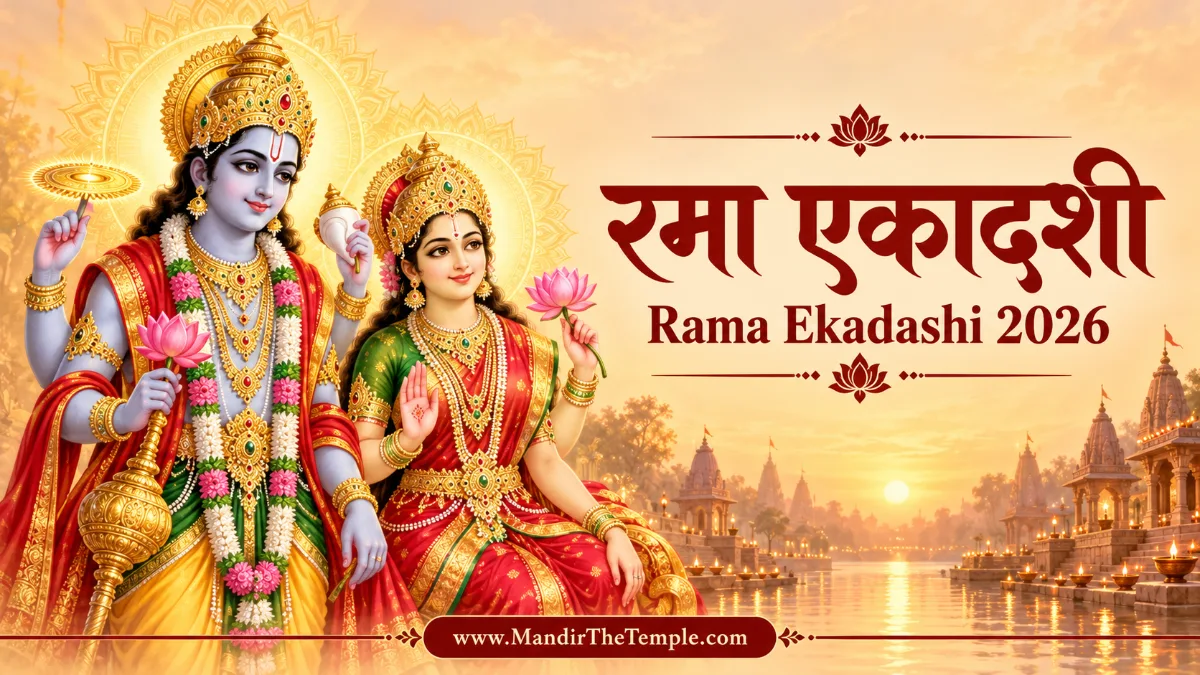
Rama Ekadashi is the Ekadashi of Kartik Krishna Paksha, the waning fortnight of Kartik, when Lord Vishnu is worshipped together with Goddess Lakshmi. “Rama” is one of Lakshmi’s names, so this Ekadashi is a day of Lakshmi-Narayana worship. Some calendars and articles also call it Rambha Ekadashi.
It falls about four days before Diwali. Govatsa Dwadashi (Vasu Baras) follows, and then Dhanteras opens the festival of lights. Many families treat Rama Ekadashi as the spiritual start of Diwali, a day to clean the mind along with the house.
By tradition, Lord Krishna explained the glory of this fast to King Yudhishthira through the story of King Muchukunda, his daughter Chandrabhaga and her husband Shobhana. This guide covers the date, parana time, the full vrat katha, Lakshmi-Vishnu puja vidhi, mantras, fasting rules and the link with Diwali.
Rama Ekadashi Date 2026: Tithi and Parana Time
Quick answer: Rama Ekadashi 2026 is on Thursday, 5 November 2026. As per the New Delhi panchang, Ekadashi tithi runs from about 11:03 AM on 4 November to about 10:35 AM on 5 November. Parana is on the morning of Friday, 6 November 2026 (roughly 6:37 to 8:48 AM in New Delhi, with Dwadashi lasting until about 10:30 AM) — check the exact time for your city in the table below.
Next Rama Ekadashi
Rama Ekadashi 2027
25 October 2027, Monday 349 days to go
- Month and paksha
- Kartik Krishna
- Ekadashi tithi
- 25 Oct 05:42 – 26 Oct 03:24
- Parana (breaking the fast)
- 26 Oct, 13:12 – 15:26
- Vaishnava / ISKCON fast
- 26 October 2027, Tuesday · Parana: 27 Oct, 06:29 – 08:43
| Year | Fasting date | Ekadashi tithi | Parana |
|---|---|---|---|
| 2026 | 5 November 2026, Thursday | 4 Nov 11:05 – 5 Nov 10:37 | 6 Nov, 06:36 – 08:47 |
| 2027 | 25 October 2027, Monday Vaishnava: 26 Oct | 25 Oct 05:42 – 26 Oct 03:24 | 26 Oct, 13:12 – 15:26 |
| 2028 | 14 October 2028, Saturday | 14 Oct 01:14 – 14 Oct 22:30 | 15 Oct, 06:22 – 08:39 |
| 2029 | 2 November 2029, Friday | 2 Nov 02:24 – 3 Nov 00:00 | 3 Nov, 06:34 – 08:46 |
Dates follow the Smarta tradition by sunrise in the selected city (Delhi) and move forward automatically every year. Choose your city above for local timings. Times are approximate; check your local panchang.
When Ekadashi touches sunrise on two days, the Smarta (householder) and Vaishnava dates can differ. This time both traditions fast on the same day in India, but abroad (for example in the USA and Canada) the date can fall a day earlier because of local sunrise. Always take your date from the table above.
Rama Ekadashi Meaning and Other Names
What “Rama” means
In Sanskrit, “Rama” means the one who delights, the one in whom the heart rests. It is a well-known name of Goddess Lakshmi, which is why Lord Vishnu is called “Ramapati” or “Ramanatha”, the lord of Rama. So Rama Ekadashi simply means the Ekadashi named after Goddess Lakshmi.
This Ekadashi is not directly connected with Lord Shri Rama. “Rama” and “Ram” sound alike, but here the word refers to Lakshmi. That is why Lakshmi puja is part of the day along with Vishnu puja.
Other names
- Rambha Ekadashi — used in some English and regional articles.
- Kartik Krishna Ekadashi — in the Purnimanta calendar of North India.
- Ashwin Krishna Ekadashi / Ashwayuja Bahula Ekadashi — in the Amanta calendar of South and West India.
- Punyadayini Ekadashi — “the giver of merit”, a name found in some katha texts.
Month in Purnimanta and Amanta calendars
In North India the month ends on Purnima (Purnimanta), so this Ekadashi falls in Kartik Krishna Paksha. In Maharashtra, Gujarat, Karnataka, Andhra Pradesh and Telangana the month ends on Amavasya (Amanta), so the same day is called the Ekadashi of Ashwin Krishna Paksha.
The day is the same in both systems; only the month name changes. It usually falls in late October or early November, after Papankusha Ekadashi and before Devuthani Ekadashi.
Rama Ekadashi Significance
Religious significance
By tradition, the Rama Ekadashi fast is believed to lighten the weight of even grave sins and to fulfil good wishes. Katha texts compare its fruit to Kamadhenu, the wish-fulfilling cow.
Both Vishnu and Lakshmi are worshipped on this day. Keeping the fast just before Diwali is believed to bring peace, happiness and lasting prosperity to the home, and many families begin lighting Diwali lamps from this evening.
The Ekadashi falls in Kartik, which the Vaishnava tradition also calls the month of Damodara. Kartik is known for deep daan (offering lamps), Tulsi worship and Vishnu bhakti. Some traditions worship Lord Vishnu in his Damodara form on Rama Ekadashi.
Spiritual message
The heart of the katha is faith. Shobhana kept the fast, but out of fear and compulsion, so the kingdom he earned was unstable. Chandrabhaga had fasted with devotion since childhood, and her merit made it permanent. The feeling behind an act matters more than its outward form.
The story also speaks of selfless love. Chandrabhaga gave away the merit of years of fasting for her husband’s sake. Devotion is not only for oneself; it can be offered for the good of family and loved ones.
Finally, it reminds us what Lakshmi really means. She is not only money but also auspiciousness, beauty, contentment and stability. When Lakshmi is worshipped together with Narayana, wealth is joined with dharma and wisdom.
Mention in the Puranas
Most traditions and katha collections place the glory of Rama Ekadashi in the Brahma Vaivarta Purana, where Lord Krishna answers Yudhishthira’s question. ISKCON also follows this attribution.
Some articles link the story to the Bhavishya Purana, and the Padma Purana is cited in some places for the merit of the fast. We state this as tradition and do not claim any verse numbers. The main story and characters are the same everywhere.
Rama Ekadashi Vrat Katha
Yudhishthira’s question
King Yudhishthira asked Lord Krishna, “O Janardana, what is the name of the Ekadashi in the dark fortnight of Kartik, and what is its glory?” Krishna replied, “O King, it is called Rama. It destroys even great sins. Listen to its story.”
The righteous King Muchukunda
Long ago there lived a truthful and just king named Muchukunda, a great devotee of Lord Vishnu. He is said to have been a friend of Indra, Yama, Varuna, Kubera and Vibhishana. In his kingdom no one ate on Ekadashi.
The king had a daughter named Chandrabhaga. Some versions say he named her after the sacred Chandrabhaga river that flowed through his land. She was married to Shobhana, son of King Chandrasena.
Ekadashi at the in-laws’ home
Shobhana was gentle by nature but so weak in body that he could not bear hunger even for one meal. Once, in the month of Kartik, he was staying at his father-in-law’s palace. On Dashami the king had drums beaten across the kingdom to announce that no one should eat the next day, Ekadashi.
Worried, Shobhana asked his wife what to do. Chandrabhaga said, “In my father’s kingdom not even animals and birds take food or water on Ekadashi. If you wish to eat, you will have to leave this kingdom.” Shobhana replied, “Then I too will keep the fast. Whatever God wills will happen.”
Shobhana leaves his body
Through the day he suffered from hunger and thirst. At night everyone sang bhajans and kept vigil, but his condition worsened, and at sunrise on Dwadashi he passed away.
The king performed his last rites properly. At her father’s wish, Chandrabhaga stayed at his home and kept observing every Ekadashi with devotion.
The divine city on Mount Mandarachala
By the power of the Rama Ekadashi fast, Shobhana received a beautiful divine city on Mount Mandarachala, called Devapura in some versions. It had golden pillars set with jewels, Gandharvas sang there, and Shobhana sat on the throne like a king of the gods.
The Brahmin Somasharma
One day a Brahmin named Somasharma from Muchukunda’s city reached Mandarachala on pilgrimage and recognised Shobhana. Shobhana welcomed him and asked about his father-in-law and his wife.
When Somasharma asked how he got this wonderful city, Shobhana said, “It is the fruit of the Rama Ekadashi fast. But I kept it out of compulsion, not faith, so this city is not stable. Please tell Chandrabhaga; her merit can make it permanent.”
Chandrabhaga’s journey
Somasharma returned and told Chandrabhaga everything. At first she could not believe it, but he said he had seen Shobhana and the city with his own eyes. She begged him to take her to her husband, saying that reuniting a separated couple is itself an act of merit.
He took her to the ashram of Rishi Vamadeva near Mandarachala. The sage sprinkled holy water on her while chanting Vedic mantras. Through his blessing and the power of her own fasts, her body became divine, and she reached Shobhana.
The kingdom made permanent
Overjoyed, Shobhana seated her on his left on the throne. Chandrabhaga said, “I have kept every Ekadashi with devotion since I was eight years old. I offer you the merit of all those fasts.”
By her merit the divine city became permanent and full of prosperity; by tradition it was to last until the end of the cosmic cycle. Shobhana and Chandrabhaga lived there happily together.
Other versions of the katha
In some versions King Muchukunda himself visits Mandarachala and sees Shobhana’s city, and Chandrabhaga reaches her husband through the merit of keeping Rama Ekadashi. Some short versions leave out the city’s name and the episode of Rishi Vamadeva. The core message is the same in all of them.
Fruit of the katha
Krishna concludes, “O King, the Ekadashis of both the dark and bright fortnights give equal merit. Whoever keeps Rama Ekadashi with faith and hears this story is freed from sin and reaches Vishnu’s abode.” Tradition says it lightens even sins as heavy as brahmahatya.
Rama Ekadashi Puja Vidhi (Step by Step)
Lord Vishnu and Goddess Lakshmi are worshipped together on Rama Ekadashi. The steps below suit an ordinary household; adjust them to your family custom and ability.
Dashami (the day before)
- Eat one light sattvic meal before sunset. Avoid garlic, onion, meat, alcohol and heavy food.
- Pluck the tulsi leaves you need on Dashami itself, since many families do not pluck tulsi on Ekadashi.
- Clean the house and the puja space. If Diwali cleaning is under way, finish the puja room first.
- Observe celibacy and go to sleep remembering the Lord.
Ekadashi morning and sankalp
- Wake in Brahma muhurta and bathe, adding a little Gangajal to the water if possible.
- Wear clean clothes, preferably yellow or white.
- Sprinkle Gangajal in the puja space, light a lamp, and take the sankalp holding water, akshat and a flower. State your name, gotra and the type of fast (nirjala, phalahar or one meal).
Lakshmi-Narayana puja
- Spread a yellow cloth on a chowki and place images of Lord Vishnu and Goddess Lakshmi, or a single Lakshmi-Narayana picture.
- Place a water-filled kalash with mango leaves beside it.
- Bathe Vishnu’s image with panchamrit (milk, curd, ghee, honey and water), then with clean water.
- Offer Vishnu yellow sandalwood, akshat, mauli, yellow flowers, tulsi, fruit and dry fruits.
- Offer Lakshmi lotus, rose or red flowers, roli, akshat, makhana, batasha and cowrie shells.
- Light a ghee or sesame-oil lamp and offer incense.
- Offer naivedya such as fruit, makhana kheer or a fast-friendly sweet, with a tulsi leaf on Vishnu’s plate.
- Chant one of the mantras below 108 times, and recite the Vishnu Sahasranama if you have time.
- Read or listen to the Rama Ekadashi vrat katha, ideally with your family.
- Finish with Om Jai Jagdish Hare and the Ekadashi Mata Ki Aarti.
Through the day and evening
- Avoid sleeping in the day. Chant, sing bhajans or read the Gita or Bhagavatam.
- Light lamps again in the evening. In Kartik, lamps near the Tulsi plant and at the main door (deep daan) are considered auspicious.
- You may sing the Tulsi Mata Ki Aarti beside the lamp.
- Those on a fruit fast may take their phalahar after the evening aarti.
Night jagran
If you can, keep a night vigil with bhajan and kirtan; the katha itself mentions the vigil on this night. If not, sing until late and sleep remembering the Lord. In ISKCON the emphasis is on chanting the Hare Krishna maha-mantra as much as possible.
Dwadashi and parana
- Bathe on Dwadashi morning and do a short puja of Vishnu and Lakshmi.
- Offer food to the Lord first.
- Give food, grain, clothes or dakshina to a Brahmin or someone in need.
- Break the fast within the parana time in the table with tulsi and water or prasad.
- Keep the parana meal light and sattvic. If Dhanteras falls that evening, prepare for it calmly.
Puja Samagri List
- Images of Lord Vishnu and Goddess Lakshmi (or a Lakshmi-Narayana picture)
- Chowki and a yellow cloth
- Kalash, water, Gangajal, mango leaves
- Panchamrit (milk, curd, ghee, honey, water)
- Tulsi leaves (plucked on Dashami)
- Yellow flowers, a lotus if available, roses or red flowers
- Yellow sandalwood, roli, kumkum, akshat, mauli
- Ghee or sesame-oil lamp, cotton wicks, incense, camphor
- Fruit, dry fruits, makhana, batasha
- Cowrie shells and kamal gatta (lotus seeds) for Lakshmi puja, if available
- Makhana kheer or a fast-friendly sweet for naivedya
- Tulsi or sandalwood mala for japa
- Vishnu Sahasranama and the vrat katha
- A few clay diyas for deep daan
- Grain, clothes, fruit and dakshina for daan
Rama Ekadashi Mantras
Mantras of both Vishnu and Lakshmi are chanted on Rama Ekadashi. Chant any of these 108 times on a tulsi or kamal gatta mala, with a calm mind and clear pronunciation.
1. Dwadashakshara mantra
ॐ नमो भगवते वासुदेवाय॥
Om Namo Bhagavate Vasudevaya
Meaning: I bow to Lord Vasudeva, who dwells within all beings. This twelve-syllable mantra is chanted on every Ekadashi.
2. Vishnu Gayatri mantra
ॐ नारायणाय विद्महे वासुदेवाय धीमहि। तन्नो विष्णुः प्रचोदयात्॥
Om Narayanaya Vidmahe Vasudevaya Dhimahi, Tanno Vishnuh Prachodayat
Meaning: We contemplate Narayana and meditate on Vasudeva; may Vishnu inspire and guide our intellect.
3. Mahalakshmi beej mantra
ॐ श्रीं महालक्ष्म्यै नमः॥
Om Shreem Mahalakshmyai Namah
Meaning: “Shreem” is Lakshmi’s seed syllable; the mantra offers salutations to Mahalakshmi. It is the most widely chanted Lakshmi mantra on this day.
4. Mahalakshmi mantra (Kamale Kamalalaye)
ॐ श्रीं ह्रीं श्रीं कमले कमलालये प्रसीद प्रसीद। ॐ श्रीं ह्रीं श्रीं महालक्ष्म्यै नमः॥
Om Shreem Hreem Shreem Kamale Kamalalaye Praseed Praseed, Om Shreem Hreem Shreem Mahalakshmyai Namah
Meaning: O Lakshmi, seated on the lotus and dwelling in the lotus, be pleased, be pleased; salutations to Mahalakshmi. It is recited before Diwali for the wellbeing of the home.
5. Lakshmi Gayatri mantra
ॐ श्री महालक्ष्म्यै च विद्महे विष्णुपत्न्यै च धीमहि। तन्नो लक्ष्मी प्रचोदयात् ॐ॥
Om Shri Mahalakshmyai Cha Vidmahe Vishnupatnyai Cha Dhimahi, Tanno Lakshmi Prachodayat Om
Meaning: We contemplate Mahalakshmi and meditate on the consort of Vishnu; may Lakshmi inspire us. Calling her “Vishnupatni” fits the Lakshmi-Narayana spirit of the day.
If Sanskrit is difficult, simply chant “Om Namo Narayanaya” or the Lord’s name. The feeling matters most.
Why Lakshmi and Vishnu Are Worshipped Together
On most Ekadashis only Lord Vishnu is worshipped, but Rama Ekadashi is different because of its name. Lakshmi is given an equal place beside Vishnu. It is believed that Lakshmi stays steady only where Narayana is worshipped, so the goddess of wealth is honoured together with Him.
Vishnu is offered yellow flowers and tulsi, and Lakshmi a lotus or red flowers. Makhana, kheer, batasha and cowrie shells are considered dear to Lakshmi. A lamp at the main door in the evening is a sign of welcome to her.
The katha carries the same idea. Shobhana’s divine city was a form of Lakshmi, but without faith it was unstable; Chandrabhaga’s devotion made it last. Prosperity that rests on dharma and bhakti endures.
Rama Ekadashi and Diwali: the Fast Before Dhanteras
Rama Ekadashi comes just before the five days of Diwali. The usual order of tithis is:
- Kartik Krishna Ekadashi — Rama Ekadashi fast
- Kartik Krishna Dwadashi — parana, and Govatsa Dwadashi (Vasu Baras in Maharashtra, Vagh Baras in Gujarat)
- Kartik Krishna Trayodashi — Dhanteras and Yama Deepam
- Kartik Krishna Chaturdashi — Narak Chaturdashi (Choti Diwali)
- Kartik Amavasya — Diwali and Lakshmi Puja
Because tithis begin and end at different times, Govatsa Dwadashi is sometimes observed on the evening of Rama Ekadashi itself, and Dhanteras on the evening of the parana day. Check the panchang each year, since this is only the order of tithis.
Many families see Rama Ekadashi as the spiritual opening of Deepotsav: fasting, Lakshmi-Narayana puja and lamps prepare both the house and the heart for Diwali Lakshmi Puja. A practical tip: the parana day may be Dhanteras, so keep the meal light and do not miss the parana window in the rush of shopping and preparations.
Rama Ekadashi Fasting: What to Eat and What to Avoid
What you can eat
- Seasonal fruit such as banana, apple, papaya and pomegranate
- Milk, curd, buttermilk, paneer, makhana
- Sabudana, kuttu, singhara or rajgira flour
- Potato, sweet potato and some root vegetables, as per family custom
- Peanuts, almonds, walnuts and other dry fruits
- Rock salt (sendha namak), black pepper, cumin
- Coconut water, lemon water, plain water
What to avoid
- Rice and anything made from rice
- Grains such as wheat, barley, maize and millet
- Lentils, pulses and beans
- Garlic and onion
- Meat, fish, eggs, alcohol and tobacco
- Ordinary salt (many use only rock salt)
- Very oily or stale food
The rule of no rice on Ekadashi is so widely followed that even people who are not fasting avoid rice on this day.
Nirjala fast
A nirjala fast means no food and no water for the whole day. It is the strictest form and suits only healthy people who are used to it. If you have diabetes, heart disease or blood pressure problems, are pregnant or breastfeeding, are elderly, or take regular medicines, consult your doctor before a nirjala fast.
Phalahar (fruit) fast
No grain is eaten, but fruit, milk, nuts and fast-friendly foods are allowed. Most householders keep this kind of fast, and it leaves the mind calm for worship.
One meal (ekabhukta)
Those who cannot fast fully can take one sattvic, grain-free meal in the day. This is a good option for children, the sick and the elderly. The spirit of the scriptures is to fast with faith and within one’s strength.
Rama Ekadashi Parana: When and How to Break the Fast
An Ekadashi fast is complete only when it is broken at the right time. Parana is done on Dwadashi after sunrise. See the exact parana time for your city in the table above.
- Within Dwadashi: Break the fast before Dwadashi tithi ends. Parana after Dwadashi is not considered proper.
- Not during Hari Vasara: The first quarter of Dwadashi is called Hari Vasara, and the fast is not broken then.
- Morning is best: Parana is ideally done in the morning; midday is usually avoided unless the morning is not possible.
- Smarta and Vaishnava: In years when the two dates differ, the parana day differs too. Use the table for your tradition.
How to do parana
- Bathe, bow to Vishnu and Lakshmi and offer bhog.
- Give food or daan to a Brahmin, someone in need or a cow.
- First take tulsi with water or prasad.
- Then eat a light sattvic meal. Many families include rice, since it was avoided on Ekadashi and taking it on Dwadashi marks the completion of the fast.
- Avoid tamasic food for the rest of the day.
Rama Ekadashi Do’s and Don’ts
Do’s
- Worship Goddess Lakshmi along with Lord Vishnu.
- Read or listen to the vrat katha, ideally with the family.
- Chant “Om Namo Bhagavate Vasudevaya” and “Om Shreem Mahalakshmyai Namah”.
- Light lamps near the Tulsi plant and at the main door in the evening.
- Keep the home clean, starting the Diwali cleaning with the puja room.
- Donate grain, clothes, fruit or diyas as you can.
- Stay calm and speak gently.
- Feed green fodder to cows and calves, especially where Govatsa Dwadashi is observed.
- Do parana within the time shown in the table.
Don’ts
- Do not eat rice, grains, pulses, garlic, onion or tamasic food.
- Do not pluck tulsi leaves on Ekadashi.
- Do not sleep during the day.
- Avoid anger, lies, gossip and harsh words.
- Do not let Diwali shopping crowd out the puja and katha.
- Do not pressure anyone to fast, especially the sick, the pregnant or the elderly.
- Do not break the fast during Hari Vasara or after Dwadashi ends.
- Do not make a show of the fast; the katha itself teaches that the inner feeling bears fruit.
Rama Ekadashi Myths vs Reality
Myth: Rama Ekadashi is the Ekadashi of Lord Shri Rama.
Reality: Here “Rama” means Goddess Lakshmi, not Lord Ram, which is why Lakshmi is worshipped with Vishnu. Worshipping Shri Rama, an avatar of Vishnu, is never wrong, but the name of this Ekadashi comes from Lakshmi.
Myth: The fast is only for gaining wealth.
Reality: The katha names freedom from sin and reaching Vishnu’s abode as the main fruit. Lakshmi also stands for auspiciousness, happiness and stability. Tradition holds that a sincere fast brings wellbeing to the home, but it is not a financial guarantee, and nothing replaces honest effort.
Myth: Even a weak person must keep a harsh fast, like Shobhana.
Reality: The katha’s message is faith, not severity; Shobhana’s city was unstable precisely because he fasted out of fear. Today, people who are ill, pregnant, elderly or on medication can keep a fruit or one-meal fast and should consult a doctor. The tradition itself asks us to fast within our strength.
Myth: The merit of a fast cannot be shared with anyone.
Reality: In this very katha, Chandrabhaga offers the merit of her fasts to her husband. Indian tradition holds that a fast or daan can be dedicated by sankalp to the welfare of family, ancestors or loved ones. This is a matter of faith tied to intention.
Myth: If the fast breaks by mistake, something bad will happen.
Reality: There is no need to fear an unintentional slip. Ask the Lord’s forgiveness, spend the rest of the day in discipline and give daan as you can. The tradition values sincerity above all, and you can fast again with faith on the next Ekadashi.
Benefits of Rama Ekadashi (Religious Belief)
The benefits below are religious beliefs drawn from tradition and the katha. Their fruit is believed to depend on faith, conduct and divine grace.
- The fast is believed to lighten the weight of sins committed knowingly or unknowingly.
- Worshipping Lakshmi with Vishnu is believed to bring peace and prosperity to the home.
- Katha texts compare its fruit to Kamadhenu, expressing the belief that good wishes are fulfilled.
- Because of Chandrabhaga’s story, many keep it for love and trust in married life.
- It is believed that one who keeps the fast and hears the katha with faith reaches Vishnu’s abode.
- Fasting, japa and vigil build self-control, patience and focus.
- Before Diwali, it is seen as preparing both home and heart for Lakshmi Puja.
- Daan and service help those in need, which is itself considered great merit.
Related Ekadashis and Readings
Before Rama Ekadashi comes Papankusha Ekadashi of Ashwin Shukla Paksha, just after Dussehra. After Rama Ekadashi and Diwali comes Devuthani Ekadashi of Kartik Shukla Paksha, when Lord Vishnu wakes from Yoga Nidra and Tulsi Vivah is celebrated. For the full list and dates of every Ekadashi, see our When is Ekadashi page.
For a general overview of the Ekadashi fast, you can also read the Wikipedia article on Ekadashi. Watch Ekadashi katha, aarti and bhajan videos on our YouTube channel, and follow MandirTheTemple on Instagram and Facebook for daily panchang and vrat-festival updates.
Since Rama Ekadashi is linked with Goddess Lakshmi, you can also recite the Laxmi Chalisa and sing Om Jai Laxmi Mata Aarti. For the festivals that follow, see Dhanteras Puja Vidhi and Diwali Lakshmi Puja Vidhi.
During puja you can sing Om Jai Jagdish Hare, the Ekadashi Mata Ki Aarti and the Tulsi Mata Ki Aarti. For the festival that closes Kartik, see Kartik Purnima Puja Vidhi. Check the Daily Panchang for each day’s tithi and download the Aarti Sangrah PDF.
Rama Ekadashi teaches that true prosperity is the kind that rests on faith and dharma. Keep this fast with Chandrabhaga’s sincerity and within your strength, light the lamp of the heart before Diwali, and remember Lakshmi-Narayana. May Goddess Lakshmi and Lord Vishnu fill your home with peace, happiness and auspiciousness. Om Namo Bhagavate Vasudevaya.
Frequently asked questions
When is Rama Ekadashi in 2026?
Rama Ekadashi 2026 is on Thursday, 5 November 2026, with parana on the morning of Friday, 6 November. See the date table on this page for your city’s parana time and for future years.
In which month does Rama Ekadashi fall?
It is the Ekadashi of Kartik Krishna Paksha in the North Indian Purnimanta calendar, and of Ashwin Krishna Paksha in the Amanta calendar used in Maharashtra, Gujarat and South India. The day is the same; only the month name differs.
Why is it called Rama Ekadashi?
“Rama” is a name of Goddess Lakshmi. That is why Lakshmi is worshipped along with Lord Vishnu on this Ekadashi.
Is Rama Ekadashi related to Lord Rama?
No. Here “Rama” refers to Goddess Lakshmi, not Lord Shri Rama.
Which deity is worshipped on Rama Ekadashi?
Lord Vishnu and Goddess Lakshmi are worshipped together. Since it falls in Kartik, some traditions worship Vishnu in his Damodara form.
How many days before Diwali is Rama Ekadashi?
It falls about four tithis before Diwali (Kartik Amavasya). Govatsa Dwadashi, Dhanteras and Narak Chaturdashi come in between, and Dhanteras often falls on the evening of the parana day.
What is the Rama Ekadashi vrat katha?
Shobhana, the weak son-in-law of King Muchukunda, kept the fast and died at sunrise on Dwadashi. By its merit he received a divine city on Mount Mandarachala, which was unstable until his wife Chandrabhaga offered him the merit of her own Ekadashi fasts.
Why was Shobhana's kingdom unstable?
According to the katha, he had kept the fast out of compulsion and fear, not faith. Chandrabhaga’s devoted fasts completed what was lacking.
Which Purana describes Rama Ekadashi?
Most traditions, including ISKCON, place it in the Brahma Vaivarta Purana, where Krishna tells the story to Yudhishthira. Some articles also mention the Bhavishya and Padma Puranas.
What can I eat during the Rama Ekadashi fast?
Fruit, milk, curd, makhana, sabudana, kuttu or singhara flour, potato and rock salt are commonly eaten. Rice, grains, pulses, garlic and onion are avoided.
Can we drink water on Rama Ekadashi?
Yes, except in a nirjala fast. Water is allowed in the fruit fast and the one-meal fast, and nirjala should be kept only by healthy people.
Can we eat rice on Ekadashi?
No, rice is avoided on Ekadashi, even by many who are not fasting. It can be taken at parana on Dwadashi.
When should I do the Rama Ekadashi parana?
Break the fast on Dwadashi after sunrise, after Hari Vasara ends and before Dwadashi tithi ends. See the table on this page for the exact time in your city.
What is the difference between Smarta and Vaishnava Ekadashi?
When Ekadashi touches sunrise on two days, householders (Smarta) may fast on the first day and Vaishnavas on the next. Follow your family or guru’s tradition and take the date from the table.
Which mantras are chanted on Rama Ekadashi?
“Om Namo Bhagavate Vasudevaya” for Lord Vishnu and “Om Shreem Mahalakshmyai Namah” for Goddess Lakshmi are the most common. Each can be chanted 108 times.
Can pregnant women, the elderly or diabetics keep this fast?
They can keep a light fruit or one-meal fast but should avoid nirjala. Please consult your doctor before fasting.
What if my Rama Ekadashi fast breaks by mistake?
Do not worry. Ask the Lord’s forgiveness, keep the rest of the day in discipline, give some daan, and fast again with faith on the next Ekadashi.
What should be donated on Rama Ekadashi?
Grain, clothes, fruit, diyas or dakshina, as you are able. Feeding green fodder to a cow is also considered auspicious.