
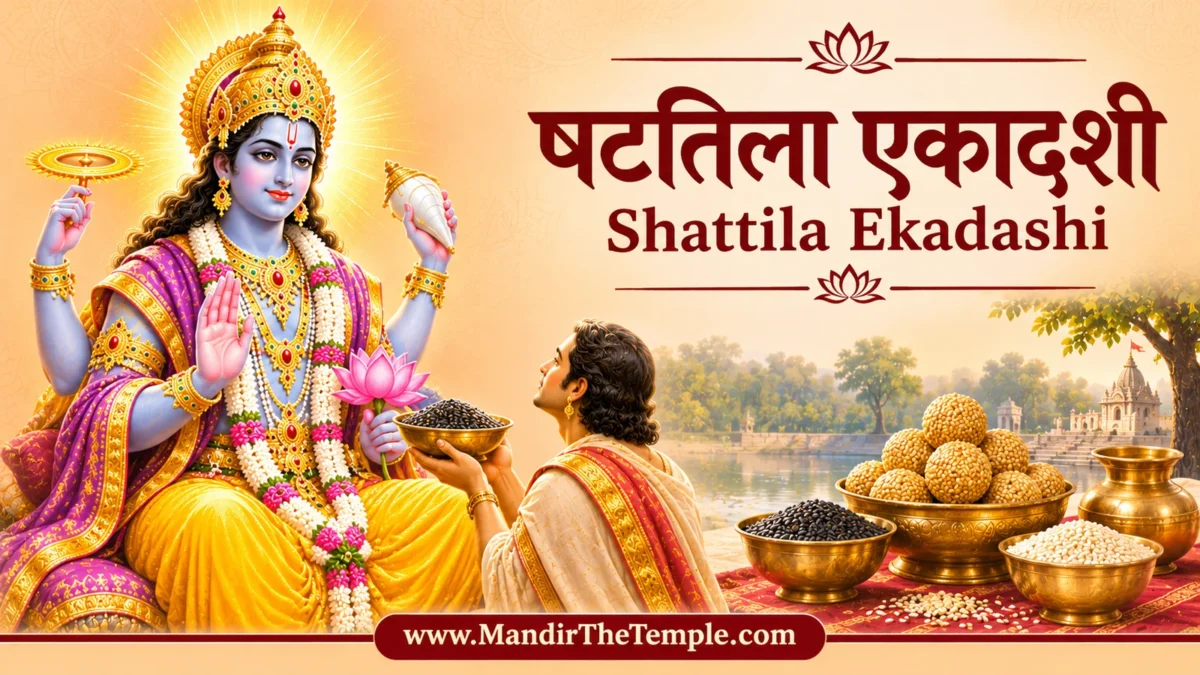
Shattila Ekadashi (षटतिला एकादशी) is the Ekadashi of the waning moon (Krishna Paksha) in the month of Magha, when devotees worship Lord Vishnu and use sesame seeds (til) in six different ways. “Shat” means six and “tila” means sesame, which is how the day gets its name. In North India it is also called Til Ekadashi or Tilda Ekadashi.
It falls in the coldest part of the year, in the middle of the Magha season of holy bathing and charity. The sesame-and-jaggery giving that families do around Makar Sankranti carries straight into this Ekadashi. Tradition holds that a Shattila fast without a gift of sesame and food is incomplete.
Shattila Ekadashi Date 2027: Tithi and Parana Time
Quick answer: The 2026 Shattila Ekadashi has already passed (it fell on 14 January 2026). The next Shattila Ekadashi fast is on Tuesday, 2 February 2027. For New Delhi, the Ekadashi tithi runs from 8:41 AM on 1 February to 11:10 AM on 2 February, and parana is on 3 February 2027 between 7:08 AM and 9:19 AM.
Next Shattila Ekadashi
Shattila Ekadashi 2027
2 February 2027, Tuesday 93 days to go
- Month and paksha
- Magha Krishna
- Ekadashi tithi
- 1 Feb 08:43 – 2 Feb 11:12
- Parana (breaking the fast)
- 3 Feb, 07:08 – 09:19
| Year | Fasting date | Ekadashi tithi | Parana |
|---|---|---|---|
| 2026 | 14 January 2026, Wednesday | 13 Jan 15:20 – 14 Jan 17:55 | 15 Jan, 07:14 – 09:21 |
| 2027 | 2 February 2027, Tuesday | 1 Feb 08:43 – 2 Feb 11:12 | 3 Feb, 07:08 – 09:19 |
| 2028 | 22 January 2028, Saturday | 21 Jan 12:18 – 22 Jan 13:06 | 23 Jan, 07:13 – 09:21 |
| 2029 | 10 January 2029, Wednesday | 10 Jan 02:21 – 11 Jan 00:57 | 11 Jan, 07:15 – 09:20 |
Dates follow the Smarta tradition by sunrise in the selected city (Delhi) and move forward automatically every year. Choose your city above for local timings. Times are approximate; check your local panchang.
The table above updates itself and shows the date and parana time for your city for this year and the next few years. Sunrise differs from city to city, so always check parana for your own location.
Smarta and Vaishnava: When the Ekadashi tithi spreads over two days, householders (Smarta) usually fast on the first day and Vaishnavas, including ISKCON, on the next. In India in 2027 both traditions fast on 2 February; only the Vaishnava parana window is a little longer. Devotees living abroad should check the table for their city.
Shattila Ekadashi Meaning and Other Names
“Shattila” joins “shat” (six) and “tila” (sesame). It is the Ekadashi on which sesame is used in six ways: bathing, body paste (ubtan), homa, tarpan, eating and charity. The vrat katha makes the same point: fasting alone is not enough, and the gift of sesame and food is the heart of this vow.
Other Names of Shattila Ekadashi
- Shat-tila / Shattila / Sat Tila Ekadashi — common spellings; “Sat Tila” is used in ISKCON calendars.
- Til Ekadashi / Tilda Ekadashi — popular names, after the use and gifting of sesame.
- Magha Krishna Ekadashi — its name in the North Indian Purnimanta calendar.
- Pausha Krishna Ekadashi — the same day in the Amanta calendar used in South and West India.
The Month in Purnimanta and Amanta Calendars
In the Purnimanta calendar of North India, a month ends on the full moon. Magha begins right after Pausha Purnima, so Shattila is the Magha Krishna Ekadashi. In the Amanta calendar of Maharashtra, Gujarat, Karnataka and the South, the same day is counted as Pausha Krishna Ekadashi.
Only the month name changes; the day is the same across India. Shattila usually falls between mid-January and early February. It comes after Pausha Putrada Ekadashi (Pausha Shukla) and before Jaya Ekadashi (Magha Shukla).
Significance of Shattila Ekadashi
Each of the 24 Ekadashis of the year carries its own message. Shattila’s message is simple: austerity must go hand in hand with generosity. Its katha is about a devotee who kept hard fasts but never fed a hungry person, and so it makes giving, especially of sesame and food, an essential part of the vow.
Religious Significance
By tradition, Magha is a month of merit. Bathing before sunrise, worshipping Vishnu and giving charity in this month are said to bring special punya. As the first Ekadashi of Magha (Purnimanta), Shattila is a key milestone in that month-long discipline.
Sesame is regarded as pure and sin-removing. It is used in ancestral rites, in homa and in the worship of deities. The belief is that using sesame in six ways on this day removes sins committed knowingly or unknowingly, and that the home never lacks food.
The Spiritual Message
The Brahmin woman fasted for a whole month until her body was frail, yet she put a lump of clay in the bowl of a guest who came begging. In the next world she received exactly what she had given: an empty house. Devotion is measured not only by ritual but by compassion.
A sesame seed is tiny, yet the katha says every seed given with faith becomes great merit. The value of a gift lies in the feeling behind it, not its size.
Mention in the Puranas
By tradition, the glory of Shattila Ekadashi is linked to the Ekadashi Mahatmya sections of the Padma Purana and the Bhavishyottara Purana. In the popular form, Lord Krishna tells the story; within it, Sage Pulastya explains the vow to Sage Dalbhya, and inside that, Lord Vishnu tells Narada the story of the Brahmin woman. Some versions have Krishna speaking to Yudhishthira, others to Arjuna.
Shattila Ekadashi Vrat Katha
Once King Yudhishthira asked Lord Krishna, “O Keshava, what is the Ekadashi of the dark fortnight of Magha called, and how should it be observed?” Krishna replied, “O King, it is called Shattila. Let me tell you what Sage Pulastya once told Sage Dalbhya.”
Sage Dalbhya had asked Pulastya, “People commit grave sins out of anger, greed or ignorance, such as killing a Brahmin, stealing or envying others, and later regret them. What can save such people from hell? What gift or merit frees them?”
Pulastya said, “You have asked a deep question, and I will tell you a secret few people know. In Magha, one should bathe daily, stay pure, control the senses and give up lust, anger, greed, delusion, envy and pride. On Pushya nakshatra, make cakes of cow dung, cotton and sesame and offer 108 oblations with them. On the Krishna Ekadashi of Magha, take the vow, worship Lord Hari with kirtan and keep a night vigil.”
“The next day, worship the Lord with incense, lamp and food, offer khichdi, give arghya, and donate a pot filled with water, sesame and, if possible, a cow to a Brahmin. It is said that the giver dwells in heaven for as many thousand years as the number of sesame seeds given. Bathing with sesame, applying sesame paste, offering sesame into fire, sesame water, eating sesame and giving sesame — these six uses destroy many sins. That is why it is called Shattila.”
The Story of the Brahmin Woman and the Lord
Pulastya then told the story that Lord Vishnu had once told Narada. Narada visited Vaikuntha and asked about the merit and origin of the Shattila fast. Vishnu said, “Narada, I will tell you something I saw with my own eyes.”
Long ago, a Brahmin woman lived on earth. Many versions describe her as a widow. She was intelligent, devoted to Vishnu and always busy with vows and fasts. Once she fasted for an entire month, and her body became very weak.
But she had one flaw. She had never given food or money to a deity, a Brahmin or anyone in need. The Lord thought, “Her fasting has purified her body and she will reach my abode, but she has never given food. Without that, how will she ever be satisfied?”
So the Lord took the form of a poor mendicant, came to her door and asked for alms. She did not recognise him. Instead of grain, she dropped a lump of clay into his begging bowl. The Lord quietly took it and returned to his abode.
In time, the woman left her body and, by the merit of her fasting, reached heaven. There she was given a fine house (a hut in many versions) and a mango tree. But the house was completely empty — no grain, no clothes, nothing. The clay she had given had become a house with nothing in it.
Distressed, she went to the Lord and said, “I kept so many fasts and worshipped you always. Why is my house empty?” The Lord replied, “You fasted, but you never gave food. When I came to your door as a beggar, you gave me a lump of clay. That is why your house is bare.”
She folded her hands and asked what to do. The Lord said, “Go home. Celestial women (devastris) will come to see you. Do not open the door until they have told you the glory and method of Shattila Ekadashi.”
She did as told. When the celestial women came and asked her to open the door, she said, “If you wish to meet me, first tell me the glory of Shattila Ekadashi.” One of them explained the whole vow. Only then did she open the door.
She then kept the Shattila fast with full faith, used sesame as prescribed and gave sesame and food in charity. By the power of the vow she became radiant, and her house filled with grain, wealth and everything she needed.
The katha ends with the teaching that one should give up greed and ignorance, keep the Shattila fast and give sesame and food. By tradition this removes poverty, misfortune and sin.
Lessons from the Katha
- Austerity with charity: fasting and worship are not enough without feeding those in need.
- God in every guest: the beggar at the door may be the Lord himself, so never insult anyone who asks.
- We receive what we give: clay given became an empty house.
- A chance to correct: the Lord did not punish her; he showed her a way to set things right.
Shattila Ekadashi Puja Vidhi (Step by Step)
This method follows common household practice. If your family or sampradaya does it differently, follow your own tradition.
- Dashami preparation: On Dashami, eat a simple sattvic meal before sunset and avoid grains at night. Keep away from onion, garlic, meat and alcohol. Keep black or white sesame, sesame oil, jaggery and donation items ready.
- Morning sesame bath: Rise before sunrise on Ekadashi. Add a little sesame to your bath water. You may first rub on a paste of ground sesame with a pinch of turmeric or gram flour. If possible, take a Magha snan in a holy river.
- Sankalp: Sit at your altar in clean clothes. Holding water, rice, sesame and a flower, state your name and the date and resolve: “I keep the Shattila Ekadashi fast to please Lord Vishnu, and I will give sesame and food as I am able.”
- Set up the altar: Spread a yellow cloth on a low stool and place an image of Vishnu or Krishna. Sprinkle Ganga jal and light a ghee lamp; a sesame-oil lamp can also be lit.
- Worship: Bathe the deity with Ganga jal and offer yellow sandal paste, rice, yellow flowers, tulsi leaves, incense and the lamp. Offer til-gud laddoos or sesame kheer, with a tulsi leaf on the bhog.
- Mantra and katha: Chant “Om Namo Bhagavate Vasudevaya” at least one mala (108 times). Read or listen to the Shattila katha. Vishnu Sahasranama may also be recited.
- Sesame homa: If you can, offer 108 or 28 oblations of sesame mixed with cow ghee, saying “Om Namo Bhagavate Vasudevaya Svaha”. If a homa is not possible, simply offer sesame before the lamp.
- Aarti: Close with Om Jai Jagdish Hare and the Ekadashi Mata Ki Aarti, and ask forgiveness for any mistakes.
- Charity: Give sesame, jaggery, grain, blankets or warm clothes to someone in need, a Brahmin or a temple. This is the core message of the katha.
- Evening: Light a lamp again, place one near the tulsi plant (do not water it or pluck leaves today) and sing bhajans.
- Night vigil: The katha mentions jagran. If staying up all night is not possible, chant or read until late.
- Dwadashi and parana: Next morning, bathe, worship, feed a Brahmin or someone in need, give sesame, and break the fast in the parana window shown in the table above.
Puja Samagri List
- Image or idol of Lord Vishnu or Krishna
- Low stool (chowki) and yellow cloth
- Black and white sesame (separately for puja, homa and charity)
- Sesame oil and cow ghee
- Ganga jal and a copper or brass lota
- Tulsi leaves (pluck a day earlier)
- Yellow sandal paste, roli, turmeric and akshat
- Yellow flowers and a garland
- Incense, camphor and diya
- Til-gud laddoos, fruit, panchamrit and mishri
- Havan kund, mango wood or cow-dung cakes and havan samagri
- A clay pot filled with water (for charity)
- Donation items: grain, sesame, jaggery, blankets, warm clothes
Shattila Ekadashi Mantras
1. Vasudeva Mantra (twelve syllables)
Om Namo Bhagavate Vasudevaya.
Meaning: I bow to Lord Vasudeva, who pervades all. This is the most widely chanted Ekadashi mantra; one mala of 108 is customary.
2. Narayana Mantra (eight syllables)
Om Namo Narayanaya.
Meaning: I bow to Lord Narayana. It is simple enough to chant silently through the day.
3. Vishnu Gayatri
Om Narayanaya Vidmahe Vasudevaya Dhimahi, Tanno Vishnuh Prachodayat.
Meaning: May we know Narayana and meditate on Vasudeva; may Lord Vishnu guide our understanding.
4. Vishnu Dhyana Shloka
Shantakaram Bhujagashayanam Padmanabham Suresham, Vishvadharam Gaganasadrisham Meghavarnam Shubhangam. Lakshmikantam Kamalanayanam Yogibhirdhyanagamyam, Vande Vishnum Bhavabhayaharam Sarvalokaikanatham.
Meaning: I bow to Vishnu, the peaceful one who rests on the serpent, from whose navel the lotus rises, the support of the universe, beloved of Lakshmi, who removes the fear of worldly existence.
5. Homa Mantra for Sesame Offerings
Om Namo Bhagavate Vasudevaya Svaha.
Meaning: This offering is for Lord Vasudeva. It is said with each oblation of ghee-mixed sesame. Use your family’s homa mantra if it has one.
The Six Uses of Sesame (Til) on Shattila Ekadashi
The six uses of sesame are what make this Ekadashi distinct, and all of them can be done at home.
1. Til Snan (Sesame Bath)
Add a pinch or a spoonful of sesame to your bath water and remember Lord Vishnu while bathing. A river bath in Magha is especially valued, but a sesame bath at home is accepted by tradition.
2. Til Ubtan (Sesame Paste)
Grind a little sesame with turmeric, gram flour or milk and apply it before your bath, or simply massage with sesame oil. If your skin is sensitive, test a small patch first.
3. Til Homa (Sesame in the Fire)
Offer black sesame mixed with cow ghee into the sacred fire. The katha describes 108 oblations with cakes of cow dung, cotton and sesame. If a home homa is not possible, offer sesame at a temple homa or before your lamp.
4. Til Tarpan (Sesame Water for Ancestors)
Mix black sesame in water and offer it while remembering your ancestors. Formal tarpan differs by family, so follow your lineage’s custom or a priest’s guidance. Some versions count drinking sesame water (tilodak) as the sixth use instead of tarpan.
5. Til Bhojan (Eating Sesame)
If you are on phalahar, you can take til-gud laddoos, sesame chikki or sesame kheer, as long as they contain no grain flour or semolina. Those on a waterless fast take sesame prasad at parana.
6. Til Daan (Giving Sesame)
The sixth use is considered the most important: giving sesame, along with food, to those in need. More on this below.
Importance of Til Daan on Shattila Ekadashi
The whole katha turns on charity. The Brahmin woman had austerity and devotion but no generosity, so even her heavenly house stood empty. That is why gifts of sesame and food are treated as an essential part of this vow.
Pulastya’s words, that one dwells in heaven for thousands of years for every sesame seed given, are a way of praising charity. Put simply: a small gift given with faith becomes great merit.
What to Donate on Shattila Ekadashi
- Black sesame: in a vessel, or as til laddoos.
- Grain: wheat, rice, dal or flour. Even if you do not eat grain on the fast, give grain — that is the point of the story.
- A pot of water: the katha mentions giving a water-filled pot to a Brahmin.
- Blankets and warm clothes: the most useful gift in the Magha cold.
- Jaggery and ghee: traditionally given with sesame.
- Cow seva: the katha mentions gifting a cow; today, fodder or service at a gaushala is a practical form.
Shattila Ekadashi, Magha Month and Makar Sankranti
Shattila is the first Ekadashi of Magha (Purnimanta), a month known for holy bathing, charity and austerity. The Magh Mela at the Sangam in Prayagraj is held in this month, where pilgrims stay for kalpavas and bathe every day.
Makar Sankranti and Sesame
On Makar Sankranti the Sun enters Capricorn, and across India people eat and give til-gud and khichdi. In Maharashtra the greeting is “Tilgul ghya, god god bola” — take sesame-jaggery and speak sweetly.
Shattila Ekadashi usually falls close to Makar Sankranti — sometimes the same day, sometimes a few days before or after. In 2026, for example, both fell on 14 January. Many families give sesame on both occasions, and this Ekadashi carries the Sankranti tradition of til daan forward.
Shattila in the Magha Calendar
- Magha snan: a bath before sunrise, in a river or at home with sesame water, is the rule for the whole month.
- Mauni Amavasya: a few days after Shattila comes the new moon of Magha, observed with silence, bathing and charity.
- Tila Dwadashi: in some traditions the Dwadashi after Shattila is called Tila Dwadashi, and sesame is given on that day too.
What to Eat and Avoid in the Shattila Ekadashi Fast
The main Ekadashi rule is to give up grains (rice, wheat, pulses). Sesame is used freely on Shattila, but make sure sesame sweets contain no grain.
What You Can Eat
- Til-gud laddoos and sesame chikki (without flour or semolina)
- Seasonal fruit
- Milk, curd, paneer and buttermilk
- Sabudana khichdi or kheer
- Kuttu, singhara or rajgira flour (where your family accepts them)
- Boiled potato, sweet potato, arbi
- Peanuts, makhana and dry fruits
- Rock salt (sendha namak), black pepper, cumin
What to Avoid
- Rice and anything made from rice
- Wheat, barley, maize and all pulses
- Ordinary table salt — use rock salt
- Onion, garlic, meat, eggs and alcohol
- Brinjal and tamasic food (avoided in many traditions)
Nirjala Fast
A nirjala fast gives up both food and water for the day. It is the strictest form and is only for people in full health. The body needs warmth and energy in the Magha cold, so choose this only if you are sure you can manage it.
Phalahar Fast
The most common form: fruit, milk, til-gud and fasting foods once or twice in the day. Including sesame laddoos also fulfils the “til bhojan” rule.
One Meal (Ekabhukta)
Those who cannot fast all day can take one sattvic, grain-free meal. This is a practical choice for elderly, unwell or weak people.
Health caution: If you have diabetes, blood pressure problems or kidney disease, are pregnant or breastfeeding, or take regular medicines, consult your doctor before a strict fast. A phalahar or one-meal fast kept with faith is a complete fast. Take your medicines on time; tradition exempts the sick, the elderly and children.
Shattila Ekadashi Parana: When and How to Break the Fast
Parana means breaking the fast. It is done on Dwadashi, after sunrise, and doing it at the right time is considered as important as the fast itself.
Parana Rules
- Within Dwadashi: break the fast before Dwadashi tithi ends.
- Not during Harivasara: the first quarter of Dwadashi is called Harivasara; wait until it is over.
- Morning is best: avoid madhyahna (midday); if the morning is missed, break the fast after midday.
- Smarta and Vaishnava: the windows can differ; ISKCON calendars often give a longer one.
- Check your city: use the date table near the top of this page.
How to Do Parana
- Bathe on Dwadashi morning, worship Lord Vishnu and offer bhog.
- Feed a Brahmin, someone in need or a cow, and give sesame.
- First take a tulsi leaf or sesame water, then til-gud prasad.
- Then eat a sattvic meal. You may offer khichdi to the Lord, as the katha describes, and break the fast with it.
Do’s and Don’ts on Shattila Ekadashi
Do
- Bathe with sesame water and apply sesame paste in the morning.
- Offer sesame, tulsi and yellow flowers to Lord Vishnu.
- Offer til-gud laddoos as bhog.
- Read the katha and chant “Om Namo Bhagavate Vasudevaya”.
- Give sesame, grain, blankets and warm clothes as you are able.
- Offer sesame water in memory of your ancestors.
- Treat every guest or beggar at your door with respect.
- Break the fast at the right time the next day.
Don’t
- Don’t eat rice, wheat or pulses.
- Don’t pluck tulsi leaves on Ekadashi; keep them ready from the day before.
- Don’t turn away or insult anyone who asks for help — the central lesson of the katha.
- Avoid anger, lies, gossip and harsh words.
- Don’t force a strict fast when you are unwell.
Shattila Ekadashi Myths vs Reality
Myth: Giving sesame on Shattila Ekadashi guarantees wealth.
Reality: Tradition links til daan with prosperity and merit, but no ritual guarantees an outcome. The real message of the katha is not “give and you will get rich” but “be generous, because devotion without compassion is incomplete”.
Myth: Sesame is only for ancestral rites, so it is inauspicious on Ekadashi.
Reality: Sesame is used in pitru karma, but also in homa, deity worship and festivals like Makar Sankranti. This Ekadashi is named after sesame, so using it is fully in line with tradition.
Myth: Without sesame, the Shattila fast is wasted.
Reality: The six uses are the special feature of the day, but if you are allergic to sesame or cannot get it, a fast kept with devotion, chanting and a gift of food is still a full observance.
Myth: The stricter the fast, the greater the merit.
Reality: The scriptures advise fasting according to one’s strength. With diabetes, pregnancy, old age or regular medicines, a phalahar or one-meal fast taken on a doctor’s advice is a complete fast.
Myth: Only those who fast should give charity.
Reality: Anyone who cannot fast can still give sesame and food, worship Vishnu and hear the katha. The Brahmin woman’s lack was not fasting but giving, so charity has value of its own.
Myth: Breaking the fast by mistake is a grave sin.
Reality: Eating something by accident or breaking the fast because of illness is not treated as a sin. Ask the Lord’s forgiveness, chant his name, give a small gift and keep the next Ekadashi.
Benefits of Shattila Ekadashi (Religious Beliefs)
The benefits below come from religious belief and tradition; how they are experienced is said to depend on each person’s faith and conduct.
- Removal of sins: the six uses of sesame and the fast are believed to atone for sins.
- Relief from poverty: the woman’s empty house filled with grain, so the vow is linked with prosperity.
- A home never short of food: those who give food believe their own home stays blessed.
- Peace for ancestors: til tarpan expresses gratitude to the ancestors.
- Prayer for good health: the phalashruti speaks of freedom from illness — a religious belief, not a substitute for medical care.
- Compassion: the habit of giving loosens greed and deepens empathy.
- Vishnu’s grace: devotees believe devotion and charity on this day please Lord Vishnu.
Related Ekadashis and Readings
Just before Shattila comes Pausha Putrada Ekadashi of Pausha Shukla, kept for the blessing of children. After Shattila comes Jaya Ekadashi of Magha Shukla. See all the dates of the year on our Ekadashi Kab Hai page.
For the puja, read Om Jai Jagdish Hare, Ekadashi Mata Ki Aarti and Tulsi Mata Ki Aarti. Check the Daily Panchang for tithi and muhurat, or download the Aarti Sangrah PDF.
Shattila Ekadashi reminds us that the path to God runs not only through fasting but through feeding others. In this cold month of Magha, give someone a handful of sesame, a little grain or a blanket, and offer that gift at the Lord’s feet. May Lord Hari keep your home full of food, wealth and peace. Om Namo Bhagavate Vasudevaya.
Frequently asked questions
When is Shattila Ekadashi in 2027?
The next Shattila Ekadashi fast is on Tuesday, 2 February 2027, with parana on the morning of 3 February (about 7:08 to 9:19 AM in New Delhi). For later years and your own city, see the date table on this page.
When was Shattila Ekadashi in 2026?
It fell on 14 January 2026, the same day as Makar Sankranti. The next fast is in 2027.
In which month does Shattila Ekadashi fall?
It is Magha Krishna Ekadashi in the North Indian Purnimanta calendar and Pausha Krishna Ekadashi in the Amanta calendar. The day is the same everywhere, usually in January or February.
Why is it called Shattila Ekadashi?
‘Shat’ means six and ’tila’ means sesame. Sesame is used in six ways on this day — bath, body paste, homa, tarpan, food and charity.
What are the six uses of sesame on Shattila Ekadashi?
Bathing in sesame water, applying sesame paste, offering sesame in homa, offering sesame water to ancestors (tarpan), eating sesame and donating sesame. Some versions count drinking sesame water in place of tarpan.
What is the Shattila Ekadashi vrat katha?
A Brahmin woman kept many fasts but never gave food. When the Lord came as a beggar she gave him a lump of clay, so in heaven she found an empty house. After learning the Shattila vow from celestial women and giving sesame and food, her house filled with grain and wealth.
What should I donate on Shattila Ekadashi?
Black sesame, til laddoos, grain, jaggery, ghee, a pot of water, blankets and warm clothes are traditional gifts. Give according to your means and with respect.
Can we eat sesame on Shattila Ekadashi?
Yes. Eating sesame is one of the six uses. Til-gud laddoos or chikki are fine on phalahar as long as they contain no grain flour or semolina.
What can I eat during the Shattila Ekadashi fast?
Fruit, milk, curd, sabudana, kuttu or singhara flour, potato, sweet potato, makhana, peanuts and rock salt. Sesame-jaggery sweets are especially popular on this Ekadashi.
Can we eat rice on Ekadashi?
No. Rice and all grains and pulses are avoided on Ekadashi. By tradition, even those not fasting avoid rice on this day.
Can I drink water during the Shattila Ekadashi fast?
Yes, except on a nirjala (waterless) fast. Only people in full health should attempt a nirjala fast.
When and how should I do Shattila Ekadashi parana?
Break the fast on Dwadashi after sunrise, after Harivasara ends and before Dwadashi tithi ends. Worship and give charity first, then take tulsi or sesame water; check your city’s time in the table on this page.
What is the difference between Smarta and Vaishnava Shattila Ekadashi?
When the tithi spans two days, Smartas (householders) usually fast on the first day and Vaishnavas, including ISKCON, on the second. In India in 2027 both fast on the same day.
Which mantra should I chant on Shattila Ekadashi?
‘Om Namo Bhagavate Vasudevaya’ is the most common. ‘Om Namo Narayanaya’ and the Vishnu Gayatri are also chanted, and ‘Om Namo Bhagavate Vasudevaya Svaha’ is said during sesame homa.
How is Shattila Ekadashi related to Makar Sankranti?
Both centre on eating and giving sesame, and Shattila usually falls close to Makar Sankranti. Many families give til-gud and grain on both occasions.
Can pregnant women and elderly people keep the Shattila fast?
They can keep a light phalahar or one-meal fast with a doctor’s advice. Tradition exempts the pregnant, sick, elderly and children from strict rules, and worship, chanting and charity are also meritorious.
What if my Shattila Ekadashi fast breaks?
Don’t worry. Ask Lord Vishnu’s forgiveness, chant his name, give some sesame or food, and keep the next Ekadashi with devotion.
Can I pluck tulsi leaves on Shattila Ekadashi?
No, by tradition tulsi leaves are not plucked on Ekadashi. Pluck them a day earlier for the puja.